
Missing most or all of your teeth can make eating, speaking, and smiling feel difficult. Traditional dentures often slip or feel uncomfortable, leaving many people searching for a better solution.
All-on-X dental implants are revolutionizing smile restoration by replacing an entire arch of teeth with just four to six strategically placed implants, giving you a permanent, stable set of teeth that look and feel natural.
Unlike removable dentures that sit on your gums, All-on-4 refers to a specific type of fixed implant denture that attaches directly to your jawbone. This approach means you can eat your favorite foods again without worry. You’ll also speak clearly and smile with confidence.
The All-on-X technique works for people who have lost multiple teeth or need full-mouth restoration.
Dental implants are small, threaded posts that surgically replace missing teeth and can last a lifetime with proper care. This treatment combines advanced technology with proven implant methods to give you results that change how you feel about your smile.
Key Takeaways
- All-on-X implants replace a full arch of teeth using only four to six strategically placed implants for maximum stability
- You can eat, speak, and smile naturally since the implants attach directly to your jawbone rather than sitting on your gums
- Advanced materials and surgical techniques make All-on-X a long-lasting solution that can restore both function and appearance
How All-on-X Dental Implants Are Redefining Smile Restoration

All-on-X dental implants offer a new way to replace missing teeth with permanent prosthetic teeth. This method works differently from removable dentures and traditional implants by using fewer implants to support a full arch of teeth.
The Concept of All-on-X and Its Unique Approach
All-on-X implants use a smart design that places four to six implants in your jaw to hold a complete set of teeth. The “X” stands for the number of implants used, which can be four, five, or six depending on your needs.
Your dentist angles some implants to make the most of your existing bone. This means you might not need bone grafts that other treatments require. The back implants tilt at specific angles to avoid sensitive areas like nerves and sinuses.
Key benefits of this approach:
- Uses fewer implants than traditional methods
- Works with less bone volume
- Reduces need for additional surgeries
- Faster treatment time
The dental prosthesis attaches directly to these implants. This creates a strong foundation that feels more natural than removable dentures.
Permanent Prosthetic Teeth Versus Removable Dentures
Your all-on-X implants give you prosthetic teeth that stay in place all the time. You cannot remove them like traditional dentures. This makes eating and speaking much easier.
Removable dentures can slip when you eat or talk. They need special adhesives and daily removal for cleaning. All-on-X prosthetic teeth work more like your natural teeth.
Comparison between options:
| Feature | All-on-X Implants | Removable Dentures |
| Stability | Fixed in place | Can slip or move |
| Eating ability | Bite force up to 70% of natural teeth | Limited to soft foods |
| Daily care | Brush like normal teeth | Remove and soak nightly |
| Bone preservation | Prevents bone loss | Bone continues to shrink |
Your permanent prosthetic teeth let you eat foods that denture wearers often avoid. Corn on the cob, apples, and nuts become possible again.
Advantages Over Traditional Dental Implants
Traditional dental implants usually need one implant for each missing tooth. If you need a full mouth restoration, this means 14 to 16 implants per jaw. All on x implants only need four to six implants for the same result.
The treatment time is much shorter with all-on-X implants. You often get temporary teeth on the same day as your surgery. Traditional implants can take six months to two years to complete.
Cost differences are significant:
- All-on-X: One procedure for full arch
- Traditional implants: Multiple surgeries over months
- Fewer office visits needed
- Less time off work
Your healing time is faster because fewer implants are placed. The angled placement technique also uses stronger bone areas in your jaw. This makes the implants more stable from the start.
All-on-X dental implants also preserve more of your natural bone structure. When you lose teeth, your jawbone starts to shrink. These implants help maintain your facial shape better than removable options.
Discover the life-changing benefits of All-on-X implants. Schedule your appointment today with our Wilmington, NC specialists and start your journey to a better smile!
Who Can Benefit From All-on-X and Full-Mouth Restoration
All-on-X dental implants provide an excellent solution for enhancing and restoring your smile for patients with extensive tooth loss. This treatment works well for people with compromised bone density who need full-arch tooth replacement without individual implants for every missing tooth.
Ideal Candidates for All-on-X
You might be a good candidate for All-on-X if you have lost most or all of your teeth in one or both arches. This treatment works best when you have adequate bone density to support the implants.
Ready to explore how All-on-X dental implants can restore your smile? Book your consultation with our expert team in Wilmington, NC, and take the first step toward a permanent, beautiful smile.
Key candidate requirements:
- Sufficient jawbone density for implant placement
- Good overall health and oral hygiene habits
- Commitment to following post-treatment care instructions
- Realistic expectations about treatment outcomes
Your dentist will check your bone structure using X-rays or CT scans. If you have some bone loss, you may still qualify since All-on-X can often eliminate the need for bone grafting due to the angled placement of the implants.
You should have healthy gums without active gum disease. Any existing oral health problems need treatment before getting implants.
Your medical history matters too. Certain conditions or medications can affect healing, so your dentist will review these during your consultation.
Managing Severe Tooth Loss and Bone Loss
If you have severe tooth loss, All-on-X offers a practical solution that addresses both missing teeth and bone preservation. Traditional dentures don’t prevent bone loss, but implants stimulate your jawbone like natural tooth roots.
When you lose multiple teeth, your jawbone starts to shrink. This process happens because the bone needs stimulation from tooth roots to stay healthy.
All-on-X is especially advantageous for those with significant bone loss since the angled implant placement uses available bone more effectively. The posterior implants are tilted to avoid areas where bone density is poor.
Benefits for severe cases:
- Immediate function: You get temporary teeth the same day
- Fewer surgeries: Often no bone grafting needed
- Faster healing: Less invasive than individual implants
- Cost effective: Less expensive than replacing each tooth individually
This approach works well even if you’ve worn dentures for years and experienced bone loss.
Supporting Jawbone and Facial Structure
Your facial structure depends on proper support from your teeth and jawbone. When you lose teeth, this support disappears and can create a sunken appearance.
All-on-X implants help maintain your natural face shape. The implants stimulate your jawbone, which prevents further bone loss and preserves your facial contours.
By restoring the full dental arch, these implants restore the underlying support structure of the lower face. This support can give you a more youthful appearance.
The fixed prosthetic arch sits at the proper height to support your lips and cheeks. This positioning helps restore the vertical dimension of your face that may have collapsed due to tooth loss.
You’ll also notice improvements in your ability to speak clearly. Missing teeth can cause speech problems, but full-arch tooth replacement restores proper tongue positioning and airflow.
Comparing with Individual Tooth Replacement
Individual tooth replacement requires one implant for each missing tooth. If you need to replace a full arch, this means 10-14 implants per arch, making it expensive and time-consuming.
All-on-X can be an excellent option for patients who have lost a full arch of teeth who want the stability of dental implants but for whom replacing each tooth individually would be impractical or too costly.
All-on-X advantages over individual implants:
| Factor | All-on-X | Individual Implants |
| Number of implants | 4-6 per arch | 10-14 per arch |
| Treatment time | Often same day | Several months |
| Cost | Lower overall | Much higher |
| Bone grafting | Usually not needed | Often required |
Individual implants work better when you have healthy bone density and only need to replace scattered teeth. But for full-mouth restoration, All-on-X provides a similar function with fewer implants and less complexity.
Your jawbone condition often determines which option works best. If you have good bone density throughout your jaw, individual implants might be suitable. But if you have areas of bone loss, All-on-X can work around these problem areas more easily.
The Treatment Process: From Consultation to New Smile
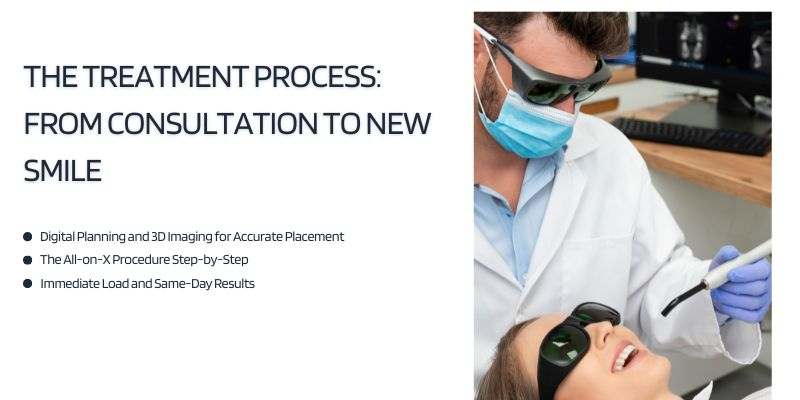
The All-on-X treatment combines advanced digital planning with precise surgical techniques to deliver your new smile efficiently. Modern 3D imaging technology guides every step, while the streamlined procedure often provides functional teeth in just one day.
Digital Planning and 3D Imaging for Accurate Placement
Your journey begins with detailed digital scans that create a complete 3D model of your jaw structure. Advanced cone beam CT scanners and 3D printers help dentists plan your treatment with extreme precision.
This digital planning phase eliminates much of the guesswork from traditional implant placement. Your dentist can identify the best angles and positions for each implant before surgery begins.
Key benefits of digital planning include:
- Precise implant positioningbased on your unique bone structure
- Reduced need for bone graftingin many cases
- Shorter surgery timesdue to pre-planned placement
- Better long-term outcomeswith optimized implant angles
The 3D imaging also helps create your temporary prosthesis in advance. This means your new teeth are ready to attach immediately after implant placement.
The All-on-X Procedure Step-by-Step
The actual All-on-X procedure follows a systematic approach designed for efficiency and comfort. Most procedures take 2 to 4 hours per arch, including any necessary extractions.
The procedure typically includes these steps:
- Tooth extractions(if needed) to prepare the treatment site
- Implant placementof 4-8 strategically angled dental implants
- Immediate attachmentof your temporary prosthesis
- Final adjustmentsto ensure proper fit and comfort
Your dentist places the implants at specific angles to maximize contact with healthy bone tissue. This angled placement technique allows for secure anchoring even in areas with reduced bone density.
Sedation options like oral sedation and nitrous oxide help keep you comfortable throughout the dental implant procedure. Most patients report minimal discomfort during the actual surgery.
Immediate Load and Same-Day Results
One of the biggest advantages of All-on-X is leaving your appointment with functional teeth. Your temporary prosthesis attaches directly to the newly placed implants on the same day.
These temporary teeth allow you to eat soft foods and speak normally while your implants heal. The design distributes chewing forces evenly across all implants to protect the healing process.
Your healing timeline looks like this:
- Day 1:Leave with temporary teeth in place
- Week 1:Mild swelling and tenderness subside
- Months 3-6:Osseointegration bonds implants to jawbone
- Final step:Receive your permanent restoration
During the 3-6 month healing period, osseointegration occurs as your jawbone grows around each implant. This natural fusion process creates the strong foundation needed for your permanent teeth.
Your final prosthesis offers improved strength, aesthetics, and comfort compared to the temporary version. The completed treatment provides a stable, natural-looking smile that can last for decades with proper care.
Oral Health, Functionality, and Aesthetics After All-on-X
All-on-X implants create dramatic improvements in how you chew, speak, and maintain your oral health. The treatment restores your jawbone strength while giving you a natural-looking smile that functions like real teeth.
Restoring a Functional Smile
Your new All-on-X teeth work almost exactly like your natural teeth. You can bite into apples, chew steak, and eat corn on the cob without worry.
The implants anchor directly into your jawbone. This creates a stable foundation that won’t slip or move when you eat. Unlike traditional dentures, you don’t need adhesives or special cleaning tablets.
Chewing Power Comparison:
- Natural teeth: 100% chewing force
- All-on-X implants: 80-90% chewing force
- Traditional dentures: 20-25% chewing force
Your speech will sound natural too. The fixed teeth stay in place when you talk. You won’t have the whistling sounds or unclear words that often come with removable dentures.
Most people can eat normally within a few weeks after healing. Your dentist will guide you through a gradual diet progression from soft foods to regular meals.
Long-Term Oral Hygiene and Maintenance
Caring for your All-on-X teeth is similar to caring for natural teeth. You brush twice daily with a soft-bristled toothbrush and use antibacterial mouthwash.
Daily Care Routine:
- Brush gently around implant sites
- Use water flossers or special floss threaders
- Rinse with antimicrobial mouthwash
- Avoid hard or sticky foods initially
Regular dental visits become even more important. Your dentist will check the implants and clean areas you can’t reach at home. These appointments help prevent infection around the implant sites.
You should visit your dentist every three to four months during the first year. After that, twice-yearly visits are usually enough if your oral health stays good.
The bridge attached to your implants may need replacement after 10 to 15 years. However, the implants themselves often last a lifetime with proper care.
Preserving Bone and Gum Health
All-on-X implants stop the bone loss that happens after tooth extraction. When you lose teeth, your jawbone starts to shrink because it’s not being used.
The titanium implants act like tooth roots. They stimulate your jawbone when you chew and keep it strong and healthy. This prevents the sunken facial appearance that comes with bone loss.
Your gum tissue will heal around the implants and form a protective seal. This barrier keeps bacteria from reaching the implant surface and causing infection.
Bone Health Benefits:
- Maintains facial structure
- Prevents further bone loss
- Supports surrounding teeth
- Keeps jaw muscles active
The implants also support your remaining natural teeth if you have any. They help distribute chewing forces more evenly across your mouth.
Good oral hygiene keeps your gums healthy around the implants. Healthy gums are pink, don’t bleed when you brush, and fit snugly around the implant posts.
Innovations and Materials: Technology Advancements in All-on-X Implants
New materials and digital tools have made All-on-X implants safer and more precise. These advances help your dentist plan better and give you stronger, longer-lasting results.
Modern Materials and Titanium Implants
Titanium implants are the gold standard for All-on-X procedures. Your body accepts titanium well because it bonds naturally with bone tissue. This process is called osseointegration.
Modern titanium implants have special surface treatments. These surfaces help bone grow faster around your implant. Some implants have tiny grooves or coatings that speed up healing.
New alloy mixtures make implants even stronger. Your implants can now handle more bite force without breaking. This means they last longer and work better for heavy chewing.
The implant design has also improved. Newer shapes distribute pressure better across your jawbone. This reduces stress on the bone and lowers your risk of implant failure.
Guided Surgery and Customized Prosthetic Design
3d imaging and digital planning have changed how dentists place All-on-X implants. Your dentist uses CT scans to see your bone structure in detail. This helps them plan the exact placement before surgery.
Computer-guided surgery uses this digital plan during your procedure. The dentist follows a precise map to place implants in the best spots. This makes surgery faster and more accurate.
Your dental prosthesis is designed using digital scans of your mouth. Computer programs create a custom fit that matches your bite perfectly. The prosthesis is made before your surgery day.
This planning reduces the need for bone grafts in many cases. Your dentist can place implants in areas with enough existing bone. When bone grafting is needed, digital planning shows exactly where to add bone.
Immediate Load Technology and Advanced Techniques
Immediate load technology lets you get new teeth on the same day as implant surgery. Your temporary prosthesis attaches right after implant placement. You leave the office with working teeth.
Special implant designs make immediate loading possible. These implants get better initial stability in your bone. The connection between implant and prosthesis is also stronger.
Advanced surgical techniques reduce healing time. Your dentist can minimize tissue damage during surgery. This means less pain and swelling for you.
Computer-aided manufacturing creates precise prosthetics quickly. Your temporary and final teeth fit better than ever before. The materials used are stronger and look more natural than older options.
Frequently Asked Questions
What makes All-on-X dental implants different from traditional dentures?
All-on-X dental implants attach permanently to your jawbone, unlike removable dentures that sit on top of your gums. This means you never have to take them out for cleaning or worry about them slipping while eating or talking.
The implants stimulate your jawbone just like natural tooth roots. This prevents the bone loss that often happens with traditional dentures over time.
You can eat all your favorite foods without restriction. Hard, sticky, or crunchy foods that cause problems with dentures become easy to enjoy again.
Can All-on-X dental implants help if I’ve been told I’m not a candidate for conventional implants?
All-on-X implants often work for people who can’t get regular dental implants due to bone loss. The angled placement technique uses the strongest parts of your existing jawbone.
You might avoid bone grafting procedures that are sometimes needed for traditional implants. The strategic positioning of just four to six implants can support a full arch of teeth.
Your dentist can evaluate your specific bone structure to determine if All-on-X is right for you. Even severe bone loss doesn’t automatically rule out this treatment option.
What are the long-term benefits of choosing All-on-X dental implants?
All-on-X implants can last decades with proper care, similar to how dental implants can last a lifetime with good maintenance. This makes them a cost-effective choice over time compared to replacing dentures every few years.
Your facial structure stays supported because the implants prevent jawbone shrinkage. This helps you maintain a more youthful appearance as you age.
You’ll experience improved confidence in social situations. No more worrying about denture adhesives failing or food getting stuck under removable appliances.
How does the All-on-X procedure impact the overall comfort and functionality of my teeth?
All-on-X implants feel and function like your natural teeth. You can bite with normal force and chew efficiently without the pressure points that dentures sometimes create.
Speaking becomes clearer and more natural. Unlike dentures that can affect your speech patterns, All-on-X implants don’t interfere with your tongue movement or pronunciation.
The recovery period is typically shorter than getting multiple individual implants. Many people return to normal activities within a few days of the procedure.
Is the All-on-X treatment option a good solution for anyone with missing teeth?
All-on-X works best for people who are missing most or all of their teeth in one or both arches. It’s designed as a full-mouth restoration rather than replacing just one or two teeth.
You need adequate bone density in specific areas of your jaw. Your dentist will take detailed scans to measure bone quality and quantity before recommending treatment.
Good overall health and oral hygiene habits are important for success. Conditions like uncontrolled diabetes or heavy smoking can affect healing and long-term results.
How do All-on-X dental implants contribute to preserving jawbone health?
The implants act like natural tooth roots by transferring chewing forces directly to your jawbone. This stimulation keeps the bone active and prevents the deterioration that occurs with tooth loss.
Traditional dentures rest on your gums and don’t provide this bone stimulation. Over time, this leads to facial collapse and the need for denture adjustments or replacements.
All-on-X implants maintain your jawbone volume and density for years to come. This preservation helps keep your facial proportions stable and supports long-term oral health.