
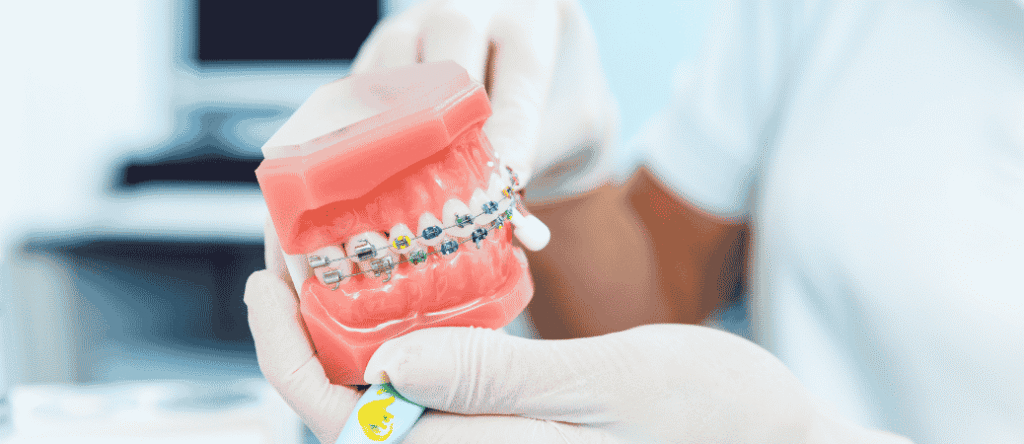
Adult orthodontic treatment trends show a clear shift toward discreet, flexible treatment options, particularly among people in their 30s, 40s, and beyond.
Clear aligners have become a major part of that shift as adults look for orthodontic care that fits professional and social routines without the visibility of traditional braces.
For adults who want a removable and less noticeable orthodontic option, Invisalign provides a clear-aligner approach that can be planned around individual tooth movement and bite needs.
Research scope
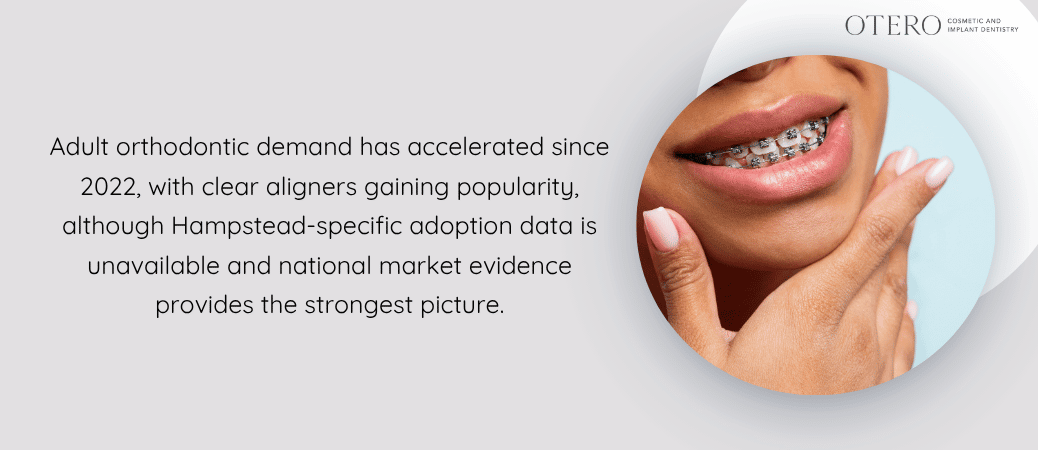
This guide is U.S.-focused, with a North Carolina overlay for Hampstead, and concentrates on why the adult segment of orthodontics (and specifically patients in their 30s, 40s and beyond) is shifting toward clear aligners rather than fixed braces.
The evidence base is strongest at the national and market level (American Association of Orthodontists survey data, peer-reviewed comparative studies, and industry market-research reporting) and weakest at the city level.
No public dataset tracks orthodontic modality choice, aligner adoption, or adult patient volume specifically for Hampstead, and the same is true for most U.S. cities of its size, so the local section below relies on North Carolina’s regulatory framework and licensing tools rather than fabricated city statistics.
Adult orthodontic demand is not a new phenomenon, but recent survey data shows it accelerating sharply since 2022, coinciding with continued double-digit growth in the clear aligner market and a major regulatory correction following the collapse of the leading direct-to-consumer aligner company. Interpretation of older cost and completion data should be weighed against that correction, since the direct-to-consumer landscape adults are choosing between today looks materially different than it did five years ago.
Adoption trends and market growth
Adult orthodontic treatment is at a record high. The AAO’s 2025 Economics of Orthodontics and Patient Census Survey, drawn from member-reported 2024 practice data, found that the number of total patients in active treatment per AAO member rose from 574 in 2022 to 696 in 2024; the highest per-member patient count recorded since the survey began in 1987, more than 10% above the prior record of 628 set in 2001.
Based on the AAO’s approximately 9,554-member database, that translates to roughly 6.66 million total patients in active treatment across the United States and Canada.
The adult share of that growth is disproportionate. The same 2025 survey estimated approximately 1.91 million adults were in active orthodontic treatment with AAO members in 2024, up from 1.64 million in 2022; a jump of roughly 16% in two years.
Adults now make up about 27% of all U.S. and Canadian orthodontic patients, and the AAO separately reports that adult patient counts have grown by nearly 40% since the early 1990s.
Clear aligners are absorbing most of this growth. Industry market-research estimates vary considerably in absolute dollar figures (a limitation discussed further below) but converge on the same structural pattern: North America holds roughly half of global clear aligner market revenue, the adult age segment is consistently reported as the single largest revenue-generating segment, and double-digit compound annual growth is projected through at least the early 2030s.
Grand View Research put the global clear aligner market at USD 5.5 billion in 2025, projecting growth to USD 17.9 billion by 2033 (a 15.2% CAGR), with adults holding a 65.1% revenue share in 2025 and North America holding a 50.0% share.
Grand View Research’s separate U.S. and North America outlooks project the U.S. market alone reaching roughly USD 15.6 billion by 2030 (a 32.2% CAGR from 2025), with adults again the largest revenue-generating age group in the 2024 baseline year.
Among orthodontists themselves, adoption is now mainstream rather than niche: a validated AAO Partners in Research survey of 160 U.S. and Canadian orthodontists found that 65.00% used clear aligner therapy (CAT) in practice, with Invisalign the dominant system (81.25% of aligner-using respondents), and 63.75% reported using CAT specifically for patients aged 31 to 45; the bracket that best approximates the “over 30” adult population this guide is concerned with, since U.S. survey data is not typically broken out at the “30-plus” threshold itself.
Why adults over 30 choose aligners over braces
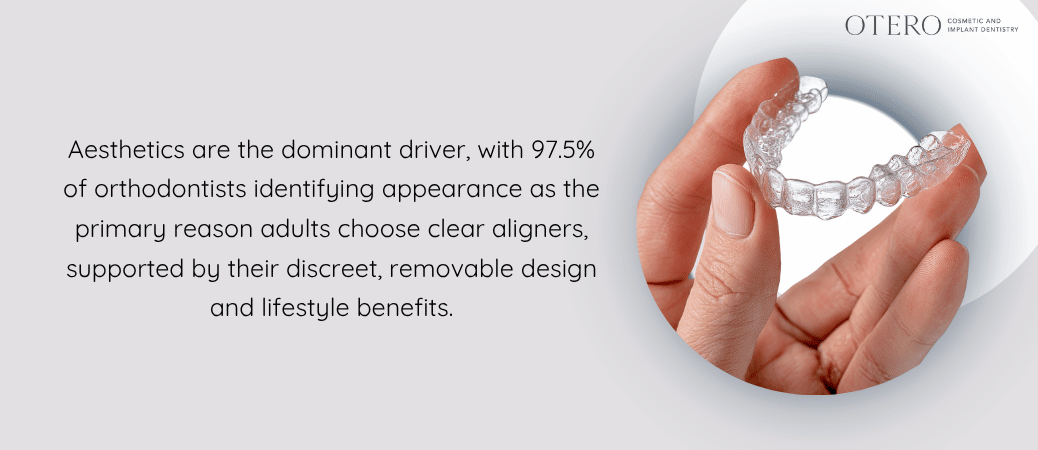
The dominant reason is aesthetic, and it is not a close second. In the same AAO Partners in Research survey, 97.5% of orthodontists believed esthetic concern was the primary reason patients sought clear aligner therapy.
That figure aligns with a broader, decades-long finding in adult orthodontic literature that appearance during treatment (not just after) is the deciding factor for working-age adults who did not treat malocclusion in adolescence.
A distinct but related driver, first named during the pandemic and still cited by clinicians, is the “Zoom boom” effect: increased self-consciousness about teeth appearance from frequent close-up video calls.
The best-quantified survey data on this mechanism comes from the British Orthodontic Society (BOS) rather than a U.S. body, but the pattern is instructive as a parallel indicator.
A 2021 BOS member survey found 84% of orthodontists reported an increase in adult patients, 65% attributed rising demand to greater awareness of adult orthodontic options, 55% cited rising patient expectations and social factors, and 88% of the adult patients driving that demand were aged 26 to 55.
A follow-up BOS survey published in December 2024 found more than 70% of orthodontists still reporting a rise in adult demand over the prior three years, with 60% specifically citing online working, socializing, and video calls as a contributing factor; suggesting the effect has outlasted the acute pandemic period rather than reverting once video-call volume declined.
Comfort and lifestyle fit reinforce the aesthetic driver.
A University of Salamanca pilot study (November 2023–February 2024) comparing 40 adult bracket patients with 40 adult Invisalign patients (mean age 33.7) found that one month into treatment, the bracket group’s oral-health-related quality of life score rose sharply, driven mainly by physical pain, while the aligner group showed no significant change in overall quality-of-life impact over the same period, although the psychological-disability dimension was the aligner group’s highest-scoring impact category, a reminder that aligners are not impact-free.
Removability is the other structural advantage adults over 30 repeatedly cite: no diet restrictions, an unchanged daily hygiene routine, and fewer visible signs of treatment in professional and social settings, all of which map directly onto the career-stage priorities of patients who are done with adolescence but not done caring how they look at work.
A final, adult-specific driver is relapse from childhood orthodontics.
Reviews of long-term orthodontic stability estimate that 40% to 90% of previously treated patients show dental alignment considered unacceptable within just 10 years of finishing retention.
Clear aligners have become a preferred retreatment tool for this population because treatment can be shorter, more discreet, and (for adults now old enough to also be managing early periodontal changes) gentler on periodontal tissue, since aligner mechanics allow lighter, more precisely staged forces than fixed appliances.
For adults whose orthodontic needs are better suited to fixed appliances, clear braces offer a less noticeable alternative to traditional metal brackets while still providing the control of fixed orthodontic treatment.
Clinical effectiveness and limitations
Head-to-head adult comparative data generally shows clear aligners performing close to, but not always matching, fixed braces on objective outcome measures, while outperforming on treatment speed and satisfaction for appropriate cases.
One 12-month comparative study found aligner patients achieved a 75% reduction in PAR (Peer Assessment Rating) index score versus 80% for braces patients, but finished treatment 1.7 months earlier on average (14.5 versus 16.2 months, p=0.01) and reported significantly higher satisfaction (p=0.001).
Accuracy studies (which compare digitally planned tooth movement to what aligners actually achieve) show more variability than marketing materials typically suggest.
A 2025 systematic review of rotational movement in adults, covering 12 studies, found reported accuracy ranging from 36% to 85%, averaging around 65%.
Deep bite correction is a documented weak point: one cited study found curve-of-Spee leveling accuracy of only 62% and overbite reduction accuracy of 61% with aligners.
A separate comparative study using the American Board of Orthodontics objective grading system found aligner-treated cases scored 13 points higher (worse) than fixed-appliance cases, corresponding to a 27% lower passing rate, with the largest gaps in posterior torque and occlusal contacts.
An age-stratified study comparing adults and teenagers found comparable aligner accuracy for rotations and vertical movement, but significantly greater over-correction in adults for horizontal movement of the mandibular incisors, a reminder that adult bone remodeling differs from adolescent bone remodeling in ways that affect predictability.
Compliance-linked risk also matters more in longer adult cases.
A retrospective analysis of 362 Invisalign patients found that each additional 10 aligner trays increased the odds of new tooth decay by 55%, with 42 or more trays identified as a clinically relevant risk threshold; a caries-risk finding tied to treatment duration rather than aligners themselves, but relevant for adults undertaking longer, more complex aligner courses.
Taken together, the clinical literature supports aligners as broadly effective for the mild-to-moderate malocclusion adult patients most often present with, while cautioning that complex rotations, significant vertical movement, and deep bite correction remain areas where fixed appliances retain a predictability advantage.
Cost, insurance, and the direct-to-consumer reckoning

Cost ranges for aligners and braces overlap substantially rather than favoring one option outright.
The ADA’s 2020 Survey of Dental Fees put traditional metal braces at $4,200 to $6,600, rising to roughly $10,000 for severe cases.
Invisalign pricing estimates cluster in the $3,000 to $8,000 range nationally, with adult-specific averages commonly cited between $3,500 and $7,000, and full “Comprehensive” adult cases averaging around $5,700.
Insurance materially narrows the gap: Align Technology-cited OrthoFi data from 2021 (112,243 insured U.S. patients) found average orthodontic insurance coverage of $1,772, with 92% of patients qualifying for coverage up to $3,000.
The most consequential recent development in this space is regulatory rather than clinical: the collapse of SmileDirectClub, once the dominant direct-to-consumer, fully remote aligner brand.
Founded in 2014 and valued at roughly $8.9 billion at its 2019 IPO, the company filed for Chapter 11 bankruptcy in September 2023 carrying nearly $900 million in debt, then abruptly shut down all operations in December 2023, leaving customers mid-treatment with no further clinical support.
In 2024, the New York Attorney General recovered $4.8 million for more than 28,000 consumers who were charged monthly installments after the company had already ceased service.
The shutdown accelerated a broader industry pivot: competitor Candid closed its 45 direct-to-consumer storefronts in 2022 and moved to a practice-centered model requiring an in-person dental visit before aligners are prescribed, and remaining remote-aligner competitors such as Byte and AlignerCo are now described as facing heightened regulatory review.
California’s 2019 direct-to-consumer teledentistry law (AB 1519) (requiring provider disclosure, patient complaint rights independent of non-disclosure agreements, and standard-of-care parity including review of recent X-rays) is frequently cited as the template other states have since followed or strengthened.
North Carolina and Hampstead Implications
For Hampstead, NC, the clinically relevant regulatory framework is primarily statewide rather than town-specific.
North Carolina’s teledentistry requirements therefore provide more useful context for patients considering orthodontic treatment than attempting to rely on local aligner-adoption statistics that are not publicly available.
North Carolina’s teledentistry statute (G.S. 90-30.2, enacted 2021) permits remote dental service delivery under a licensed dentist’s supervision but requires that patients be informed it is the dentist’s role to determine whether a condition is appropriate for a teledentistry encounter, that patients receive contact information for the North Carolina State Board of Dental Examiners and a description of the complaint process, and that any prescribing comply with the state’s Controlled Substance Reporting System.
The AAO has noted that the law preserves an in-person examination prior to orthodontic treatment, during which additional oral health issues can be identified and planned for (a meaningful distinction from the fully remote model that led to SmileDirectClub’s regulatory troubles) and that the Dental Board can take disciplinary action against licensees who limit a patient’s ability to file complaints.
For due diligence on a specific Hampstead-area practice, the most defensible public tool is the North Carolina State Board of Dental Examiners’ online license verification system, which allows searches by name or license number and displays any disciplinary actions on file. It is explicitly not a referral or locator service, but it is more reliable for screening purposes than marketing claims.
The genuine data gap for this guide is city-level adult orthodontic utilization data.
The North Carolina State Center for Health Statistics maintains historical county-level BRFSS oral health tables, but the available detailed tables date to the 2001–2010 survey cycles and cover general dental-visit recency and tooth-loss indicators (not orthodontic treatment modality or adult aligner adoption) and no current-cycle equivalent exists.
As with comparable requests for other small and mid-size U.S. metro areas, city- or county-specific figures on clear aligner adoption, adult patient volume, or DTC aligner usage simply do not exist in public data for Hampstead, and any figure claiming otherwise should be treated skeptically.
Outlook beyond 2026
Two trends are likely to continue independent of each other: the shift of the adult market toward clear aligners, and continued market growth at a high compound rate through at least the early 2030s across every industry forecast reviewed.
Multiple market-research firms diverge substantially on absolute dollar figures for the clear aligner market (estimates for the global 2025 market size alone range from roughly $4.2 billion to $8.5 billion depending on the firm and methodology, and projected 2030s endpoints vary by tens of billions of dollars) which is a genuine limitation for anyone citing a single “market size” figure with false precision.
What is consistent across firms is the direction and order of magnitude: double-digit CAGR, North American and adult-segment dominance in the near term, and continued growth driven specifically by adult demand even as some forecasts expect the teen segment to grow fastest in percentage terms later in the decade.
On the technology side, Align Technology’s newer Invisalign system is built around a proprietary AI platform (branded Luminate AI) trained on millions of previously treated cases, intended to generate more precise tooth-movement plans, reduce the need for mid-treatment refinement aligners, and shorten total treatment time for both moderate and comprehensive cases, directly targeting the accuracy and predictability gaps documented in the clinical literature above. Regulatory direction post-2026 is also reasonably predictable: state teledentistry laws modeled on North Carolina’s and California’s approach (in-person examination requirements, mandatory complaint-process disclosure, and standard-of-care parity) are likely to keep constraining any attempted resurgence of the fully remote, SmileDirectClub-style model, even as practice-integrated remote monitoring (used alongside, not instead of, an in-person relationship) continues to expand.
Bottom line
The evidence supports a straightforward conclusion: adults over 30 are choosing clear aligners over braces primarily because aligners solve the specific problem this age group cares about most (looking un-treated while being treated) without requiring a meaningfully worse clinical outcome for the mild-to-moderate cases most adults present with.
The trade-off is real but narrow: aligners show somewhat lower accuracy on complex rotations, vertical movement, and deep bite correction, and outcomes depend heavily on wear compliance in ways fixed appliances do not.
The direct-to-consumer collapse of 2023–2024 has not slowed adult demand (if anything, adult patient counts and market share rose through that period) but it has visibly shifted the market and the regulatory environment toward practice-based, in-person-examined aligner treatment rather than the fully remote model that defined the segment through the late 2010s.
References
- American Association of Orthodontists. “Member Survey Indicates Orthodontic Patient Numbers at All-Time High.” 2025 Economics of Orthodontics and Patient Census Survey.
- Grand View Research. “Clear Aligners Market Size, Share & Growth, Industry Report.”
- Grand View Research. “US Clear Aligners Market Size & Outlook, 2025-2030.”
- Grand View Research. “North America Clear Aligners Market Size & Outlook, 2030.”
- Precedence Research. “Clear Aligners Market Size to Surpass USD 113.64 Billion by 2035.”
- Towards Healthcare. “Clear Aligners Market Envisions USD 99.44 Billion by 2034.”
- Knowledge Sourcing Intelligence. “Clear Aligners Market Insights: Size, Share, Trends, Forecast 2030.”
- Roots Analysis. “Clear Aligners Market Size, Share & Growth, Industry Report.”
- FortuneDataVista. “Clear Aligners Market Size to Hit USD 35.41 Billion by 2033.” (Includes Align Technology Luminate AI product details.)
- “Insight into clear aligner therapy protocols and preferences among members of the American Association of Orthodontists in the United States and Canada.” PMC.
- British Orthodontic Society, reported in Dentistry Today. “Zoom Drives Boom in Orthodontic Services.”
- Dental Tribune. “Zoom meetings cause growing demand for orthodontics during pandemic.”
- SDMag. “Demand for tooth straightening amongst adults continues to rise.” (2024 BOS survey.)
- “A longitudinal pilot study examining the influence of the orthodontic system chosen in adult patients (brackets versus aligners) on oral health-related quality of life and anxiety.” PMC
- Orthodontic Products Online. Mayhew, M.J. “Clear Aligner Management: Adult Orthodontic Relapse Case.”
- “A Comparative Study on the Efficiency of Clear Aligners Versus Conventional Braces in Adult Orthodontic Patients.” Journal of Pharmacy and Bioallied Sciences.
- “Evaluating the Clinical Success of Clear Aligners for Rotational Tooth Movements in Adult Patients: A Systematic Review.” PMC.
- Decisions in Dentistry. “Clear Aligners vs Traditional Braces.”
- “Age-stratified assessment of orthodontic tooth movement outcomes with clear aligners.” PMC.
- “Duration-Dependent Caries Risk During Clear Aligner Therapy: A Retrospective Analysis.” PMC.
- Frontiers in Dental Medicine. “Clear aligner therapy in a periodontally compromised adult patient.”
- California Dental Association. “SmileDirectClub’s former customers may be eligible for additional refund.”
- Barchart/AP News. “SmileDirectClub is shutting down — where does that leave its customers?”
- New York State Office of the Attorney General. “Attorney General James Recovers $4.8 Million for Consumers Wrongly Charged by SmileDirectClub.”
- CBInsights. “Smilelove” company profile, citing industry commentary on Candid’s 2022 pivot from direct-to-consumer stores.
- North Carolina General Assembly. “G.S. 90-30.2. Teledentistry practice; definitions; requirements.”
- American Association of Orthodontists. “North Carolina Passes Legislation Related to Teledentistry.”
- North Carolina State Board of Dental Examiners. “License Verification.”
- North Carolina State Center for Health Statistics. “New Hanover County BRFSS Oral Health Data.”