
If you are thinking about dental implants, you likely want to know how long they last and how well they work. Jaw location plays a real role in dental implant success rates, and it can affect your outcome.
Lower jaw implants often show about a 95% success rate within the first five years, while upper jaw implants are closer to 90% due to softer bone.
Your bone density, overall health, and oral care habits also shape your implant success rates.
When you understand the dental implant success rate upper vs lower jaw, and other factors work together, you can choose the best tooth replacement option with more confidence.
Key Takeaways
- Lower jaw implants tend to have slightly higher success rates than upper jaw implants.
- Bone density and health conditions can affect how well dental implants heal and last.
- Good planning and daily care help support long-term implant success.
How Jaw Location Influences Dental Implant Success
Where your dentist places an implant in your jaw can affect how well it heals and how long it lasts. Bone density, bite force, and blood supply all change from one area to another.
Bone Density Differences Between Upper and Lower Jaws
Your lower jaw usually has thicker, denser bone than your upper jaw. Higher bone density helps the implant lock into place during healing.
Research shows that implants in the lower jaw often reach about a 95% success rate, while implants in the upper jaw average closer to 90% over five years. The difference links strongly to bone quality.
The posterior maxilla, the back part of your upper jaw, has softer, more porous bone. This area also sits near the sinus, which can limit implant length.
Because of this, upper jaw implants often need bone grafting or sinus lifts before placement.
When your dentist checks bone density with CBCT scans, they look for thin cortical bone and low bone volume.
Studies on bone quality by jaw region show that certain zones have higher risk due to weaker bone and faster bone loss.
Implant Stability and Chewing Ability

Strong bone gives your implant better initial stability. Stability matters because it supports osseointegration, the process where bone bonds directly to the implant surface.
Your lower jaw handles strong chewing forces. Even though it takes more pressure during chewing, its dense bone helps resist movement.
That support improves implant survival rate when forces stay within normal limits.
The upper jaw absorbs chewing forces differently. In the posterior maxilla, softer bone can deform more under load. If you grind your teeth or bite hard foods often, the implant may face higher stress.
A 3D finite element study on implant location, number, and prosthesis design showed that stress levels change based on implant position in the back of the lower jaw.
Designs that reduce long spans and spread force across more implants lowered stress on bone.
Your chewing ability improves when the implant stays stable. Good planning helps balance bite force and bone support.
Regional Patterns in Implant Failure Rate
Not all jaw regions carry the same implant failure rate. Early failure often links to poor initial stability, while late failure often relates to overload or bone loss.
A review of implant zones of the jaws and related success rates explains that each region has unique anatomy, blood supply, and bone resorption patterns. These factors shape long-term implant survival rate.
The posterior maxilla tends to show higher failure rates compared to the anterior mandible. Key reasons include:
- Lower bone density
- Higher need for grafting
- Greater sinus involvement
- Faster bone resorption in some patients
When you understand how jaw location affects risk, you can ask better questions during treatment planning.
Careful imaging, proper implant size, and smart prosthetic design all help reduce regional differences in implant failure rate.
Comparing Upper Jaw and Lower Jaw Implants
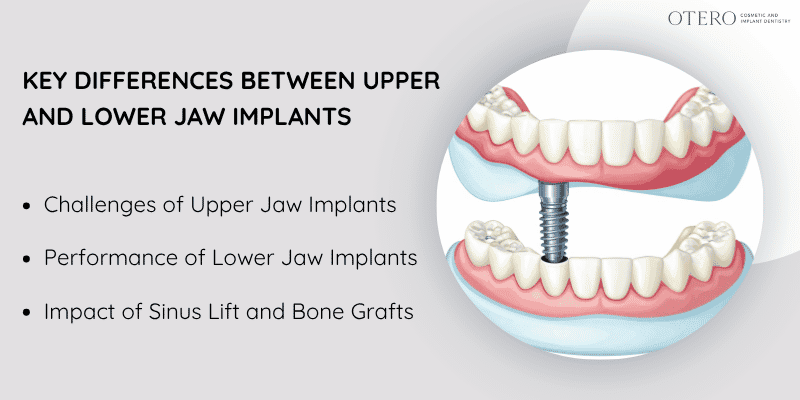
Your jaw location plays a direct role in healing time, stability, and long‑term results. Bone density, anatomy, and the need for extra procedures all affect your dental implant success rate.
Challenges of Upper Jaw Implants
When you choose upper jaw implants, you face softer bone and less natural support. The upper jaw, especially the posterior maxilla, has lower bone density than the lower jaw.
This softer bone can reduce early stability after implant placement.
Research shows a small but real difference in outcomes. Five-year data reports about a 90% success rate for upper jaw implants. That means the implant failure rate is slightly higher compared to the lower jaw.
You also need to consider the sinus cavities. The upper back teeth sit close to the sinuses. If bone height is low, your dentist may recommend a sinus lift before placing the implant.
These factors do not mean upper implants fail often. They simply require careful planning, imaging, and sometimes added procedures to improve stability.
Performance of Lower Jaw Implants
Lower jaw implants often perform better because the bone is thicker and denser. Dense bone gives the implant a strong initial grip, which supports healing.
Studies show about a 95% success rate for lower jaw implants. The higher bone density in the mandible helps reduce movement during healing, which lowers the implant failure rate.
You also avoid the sinus issue found in the upper jaw. However, your dentist must still plan around the main nerve in the lower jaw.
Proper implant placement prevents nerve irritation and protects sensation in your lip and chin.
If you want faster healing and fewer added procedures, the lower jaw often provides more predictable results.
Impact of Sinus Lift and Bone Grafts
If you lack enough bone in the upper jaw, your dentist may suggest bone grafts or a sinus lift. These procedures add or rebuild bone so the implant has solid support.
A sinus lift raises the sinus floor and places bone material underneath it. This creates space for secure implant placement in the posterior maxilla.
Bone grafts can also strengthen thin or damaged areas in either jaw. While these steps improve your dental implant success rate, they add time to your treatment plan.
Healing may take several months before your dentist places the implant.
You should weigh the extra cost and time against the benefit of better long‑term stability. Proper preparation lowers your risk of implant failure and supports lasting function.
Factors That Affect Implant Success and Failure
Your implant depends on strong bone support, healthy gum tissue, and your daily habits. When bone does not bond well or infection develops, the implant failure rate rises and can lead to early or late implant failure.
Osseointegration and Bone Quality
Osseointegration means your jawbone grows around the implant and locks it in place. This bond creates the base that holds your crown steady when you chew.
If your bone density is low, the implant may not fuse well. The upper back jaw often has softer bone, which can raise the dental implant failure risk.
Research on implant location and related success rate shows that where the implant sits in your jaw can affect outcomes.
Your surgeon checks bone height and width before surgery. If bone volume is limited, you may need grafting to improve support.
Good planning lowers the chance of early implant failure, which happens before the implant fully bonds.
Healing time also matters. You must avoid heavy pressure on the implant while the bone heals.
Peri-Implantitis and Oral Hygiene
Peri-implantitis is an infection around the implant that damages bone. It often causes late implant failure, which happens after the implant has worked well for months or years.
Plaque builds up if you skip brushing and flossing. Bacteria then inflame the gum and break down supporting bone. Studies that examine factors affecting implant failure list poor oral hygiene as a key risk.
You can lower your risk by:
- Brushing twice a day with a soft brush
- Cleaning around the implant with floss or interdental brushes
- Visiting your dentist for regular exams and cleanings
Your dentist checks for bleeding, pocket depth, and bone loss on X-rays. Early treatment can stop damage before the implant loosens.
Lifestyle and Systemic Health Considerations
Your overall health plays a direct role in implant success. Certain medical conditions and medications can slow healing and raise the implant failure rate.
For example, uncontrolled diabetes can delay bone repair. Smoking reduces blood flow to the gums and bone, which weakens osseointegration.
A review on dental implant prevalence and durability notes that systemic disorders and patient health factors influence long-term survival.
You should tell your dentist about all health conditions and medicines. This includes osteoporosis drugs, immune disorders, and past radiation to the jaw.
When you control medical issues, stop smoking, and follow care instructions, you give your implant the best chance to last.
Types of Dental Implants and Their Success Rates
Different implant types serve different needs, and success rates can vary based on design, placement method, and your bone quality.
Knowing how single-tooth, full-arch, and titanium implants perform helps you set clear expectations before treatment.
Single-Tooth Implants
A single-tooth implant replaces one missing tooth without affecting nearby teeth. Your dentist places a small titanium post in the jawbone, then attaches a crown on top.
Single-tooth implants have strong long-term results. Research shows a 95% to 98% success rate within five years, with survival rates above 90% after 20 years in many cases.
Your success depends on bone density, oral hygiene, and smoking habits. The lower jaw often shows slightly higher success because the bone is denser.
You benefit from:
- Preserved jawbone
- Natural bite force
- Easy cleaning similar to a real tooth
If you maintain good oral care and attend regular checkups, single-tooth implants can remain stable for decades.
Full-Arch Implants
Full-arch implants replace an entire row of teeth using multiple implant posts to support a fixed bridge. Dentists often use four to six implants per arch.
These implants provide strong stability and improve chewing compared to removable dentures. Studies report about a 95% five-year success rate for lower jaw implants and 90% for upper jaw implants.
Upper arches tend to show slightly lower success because the bone is softer. Your dentist may suggest bone grafting if you have bone loss.
Full-arch implants work well if you:
- Have several missing teeth
- Want a fixed, non-removable option
- Can commit to careful cleaning under the bridge
Daily hygiene and professional cleanings protect the implants that support your full arch.
Titanium Implants and Advanced Technologies
Most dental implants today use titanium implants because titanium bonds well with bone. This process, called osseointegration, creates a stable foundation for your crown or bridge.
Large reviews show that dental implants in general have an average five-year success rate between 90% and 95%, depending on location and patient factors, as explained in data on the average success rate of dental implants.
Technology also improves your outcome. Dentists now use cone beam CT guided technology to plan precise implant placement. This 3D imaging shows bone height, width, and nerve position before surgery.
Better planning leads to:
- More accurate placement
- Lower risk of nerve injury
- Improved long-term stability
When your dentist combines quality titanium implants with detailed 3D planning, you increase the chance of a smooth surgery and strong long-term results.
Role of Specialists and Technology in Long-Term Outcomes
Your choice of specialist and the way your implant is placed can affect how long it lasts. Careful planning and precise implant positioning help protect bone, gums, and nearby teeth.
Choosing a Board-Certified Oral Surgeon or Periodontist
You improve your odds of long-term success when you choose a board-certified oral surgeon or an experienced periodontist. These specialists complete years of extra training focused on surgery, bone healing, and gum health.
Dental implants show high survival rates in large real-world studies.
One long-term review of more than 10,000 implants found strong results over many years, while also noting higher risk in smokers and people with diabetes, according to this study on long term clinical performance of 10,871 dental implants.
A trained specialist will:
- Review your medical history in detail
- Check bone levels with imaging
- Screen for gum disease
- Discuss risk factors like smoking
You also benefit from proper follow-up care. Research on dental implant success rates in 2024 highlights how provider experience and long-term maintenance affect outcomes.
Implant Positioning and Advanced Placement Methods
Precise implant positioning supports better chewing force and protects nearby structures. If your dentist places the implant too close to another tooth or at the wrong angle, it can lead to bone loss or gum problems over time.
Studies show that factors like prosthetic design, bone levels, and patient health affect survival rates.
A large analysis of 20-year dental implant survival rates confirms that long-term outcomes depend on careful case selection and technique.
You may benefit from tools such as:
- 3D cone beam CT scans
- Digital surgical guides
- Computer-planned implant placement
These tools help your oral surgeon or periodontist place the implant in the correct depth and angle. Accurate implant placement supports even bite pressure, stable bone levels, and healthier gums over time.
Maintaining Implant Success Over the Years
Strong daily care and regular dental visits protect your implant survival rate. You also lower your risk of late implant failure when you act early at the first sign of a problem.

Aftercare for Long-Term Implant Survival
You protect your dental implant success rates with simple, steady habits. Brush twice a day with a soft toothbrush and clean around the implant crown and gumline.
Floss daily, and use floss made for implants or small interdental brushes if your dentist recommends them.
Professional care matters just as much as home care. In a large long-term study of over 10,000 implants, the 15-year cumulative survival rate reached 94% at the implant level. Those results depended on proper follow-up and maintenance.
Keep regular checkups every 6 months, or more often if your dentist suggests it. At these visits, your dental team will:
- Check gum health
- Measure bone levels on X-rays
- Tighten or adjust the crown if needed
If you smoke or have diabetes, you face a higher risk of implant failure. Work with your doctor to control these risks and protect your implant success rate.
Understanding and Preventing Implant Complications
Even with high dental implant success rates, problems can happen. You lower your risk when you understand what to watch for.
Two common issues include:
| Condition | What Happens | Why It Matters |
| Peri-implant mucositis | Gum inflammation around the implant | Can progress if untreated |
| Peri-implantitis | Bone loss with inflammation | Can lead to late implant failure |
Long-term data show peri-implantitis rates can rise over time, reaching 7.1% at 8 to 10 years in one large clinical review of implants followed for up to 22 years. This shows why ongoing care matters.
Call your dentist if you notice bleeding gums, swelling, pain, or a loose crown. Early treatment may include deep teeth cleaning around the implant or adjusting your bite.
You also improve outcomes by avoiding heavy grinding and wearing a night guard if you clench your teeth. Small steps like these protect your bone and help maintain your implant survival rate for many years.
Frequently Asked Questions
Dental implant success rates vary by jaw location because bone density, anatomy, and bite force are not the same in every area of your mouth.
The lower jaw often shows slightly higher success rates than the upper jaw, especially in the back molar regions.
Do dental implants last longer in the lower jaw or the upper jaw?
Dental implants often last longer in your lower jaw. The lower jaw usually has denser bone, which helps the implant fuse more firmly.
Studies report lower jaw success rates around 96–98%, while the upper jaw often ranges from about 94–96%. That small gap in percentage can matter over many years of use.
Why do implants in the upper back teeth area fail more often?
Your upper back jaw has thinner and softer bone compared to other areas. This makes it harder for the implant to gain strong initial stability.
The upper molar area also sits close to your sinus cavity. If bone height is limited, your dentist may need a sinus lift before placing the implant.
These challenges raise the risk of early movement or incomplete bone bonding.
Which jaw location has the highest risk of dental implant failure?
The highest risk usually occurs in your upper back jaw, also called the posterior maxilla. This area combines lower bone density with sinus space concerns.
Some data show five-year success rates around 90–95% in the lower jaw and slightly lower in the upper jaw, with certain upper areas closer to 85% in less favorable cases.
Smoking, uncontrolled diabetes, and poor oral hygiene increase failure risk in any location.
How does bone density in different jaw areas affect implant success?
Bone density directly affects how well your implant bonds to the jaw. Dense bone gives the implant a tighter fit at the time of surgery.
Your lower front and lower back jaw often provide stronger bone support. The upper back jaw usually has softer bone, which may require bone grafting.
Good bone support improves stability, chewing strength, and long-term survival.
Are sinus-related issues a common reason implants fail in the upper jaw?
Sinus issues can affect implants in your upper back jaw, but they are not the most common cause of failure. Limited bone height below the sinus often creates the main challenge.
If your bone is too thin, your dentist may perform a sinus lift to add bone before placing the implant. When done correctly, this procedure can support strong long-term results.
Infection, poor healing, and smoking still play larger roles in most implant failures.
Does implant success differ between front teeth and molar areas?
Yes, success can differ between your front teeth and molars. Front areas often have better bone quality and lower bite force.
Your molars handle stronger chewing pressure, which puts more stress on implants. Back teeth also sit in areas where bone may be thinner, especially in the upper jaw.
With proper planning and good oral care, both areas can achieve high success rates above 95% in healthy patients.