

Choosing between mini dental implants and standard implants can feel confusing, especially when both promise a stable smile. You want something that fits your bone, your bite, and your budget.
The decision comes down to four main factors: your jawbone strength, the number and location of missing teeth, how much pressure the implant must handle, and your long-term goals.
Mini implants are smaller and often work well when you have limited bone or need to secure a denture.
Standard implants, also called regular dental implants, are wider and usually support single crowns or bridges that handle stronger bite force.
Each option serves a purpose, but not every option fits every mouth.
When you understand how bone support, durability, cost, and personal needs shape your outcome, you can choose with confidence.
A clear comparison between mini dental implants vs standard implants helps you avoid surprises and move forward with a plan that supports your daily comfort and long-term oral health.
Key Takeaways
- Your bone level, bite force, and tooth location guide the choice between mini implants and standard implants.
- Mini dental implants and regular dental implants serve different needs and are not interchangeable.
- Long-term comfort, stability, and value matter more than size alone.
How Mini and Standard Dental Implants Differ
Mini dental implants and standard implants differ in size, design, and how dentists place and restore them. These differences affect stability, healing time, and whether you can attach a tooth right away.
Implant Size and Structure
The main difference is width. Mini dental implants (MDIs) are usually less than 3 millimeters wide, about the size of a pencil tip. Standard or traditional dental implants often measure 3.5 to 6 millimeters wide.
Mini implants use a one-piece design. The implant post and the ball-shaped abutment connect as one unit. Your dentist places it into the jawbone, and it sticks out slightly to hold a denture or crown.
Regular implants use a two-piece system. First, the dentist places the implant post into your bone. After healing, they attach a separate abutment on top.
This design often supports single crowns, bridges, or full-arch teeth with more strength.
You may hear mini implants called MDIs. Dentists often use them to secure loose dentures or in areas with limited bone.
Placement Procedure and Timeline
Mini implants usually require a less invasive procedure. Your dentist can often place them through a small pilot hole without cutting the gum tissue open.
This approach may reduce swelling and shorten your visit.
Traditional dental implants often need a small incision in your gums. The dentist places the implant into the bone and may use stitches. If you lack bone, you might need grafting before implant placement.
Because mini implants are smaller, dentists can sometimes complete treatment in one appointment. Standard implants usually take longer. You may wait several months between placement and the final crown, depending on your bone and healing response.
Healing, Osseointegration, and Immediate Loading
Both mini and regular dental implants rely on osseointegration. This process allows your jawbone to grow around the titanium post and lock it in place.
With traditional dental implants, dentists often wait three to six months for full osseointegration before attaching the final crown.
This staged approach supports long-term stability, especially for back teeth that handle strong bite forces.
Mini implants may allow immediate loading in certain cases. That means your dentist can attach a denture or temporary tooth soon after placement.
Immediate loading works best when you have enough bone density and good bite control.
However, mini implants have a smaller surface area. That can limit their use in areas with heavy chewing pressure.
Your dentist will review your bone levels, bite, and long-term goals before choosing the right option for you.
Bone and Anatomy Considerations
Your jawbone shape and strength play a direct role in which implant will work for you. Bone density, ridge width, and the need for bone grafting often decide between mini and standard implants.
Jawbone Density and Suitability
Your jawbone must hold an implant firmly while it bonds with the bone. Dentists measure bone density and width with 3D imaging, such as a CBCT scan, before they plan treatment.
Standard implants are usually 3.5 to 6 mm wide. They need enough bone thickness and strength to support biting forces, especially in the molar area.
If your bone is wide and dense, a standard implant often gives strong long-term support for crowns and bridges.
Mini implants are narrower, about 1.8 to 3 mm wide. They can fit in areas where bone is too thin for a standard implant.
If your bone is soft or thin, your dentist may suggest mini implants for denture stability instead of full biting support.
When Bone Grafting Is Required
Bone grafting builds up areas of the jawbone that have shrunk or weakened. You may need it if your ridge is too thin or too short for a standard implant.
Standard implants often require a minimum bone width. If you do not have that width, your dentist may place graft material and wait several months for healing before placing the implant.
Mini implants can sometimes help you avoid grafting. Because they are narrower, they may fit into existing bone without adding material.
Many providers explain that patients who want to avoid grafting may consider mini implants.
However, skipping grafting is not always better. If you need a strong, fixed tooth replacement in a high-pressure area, rebuilding the bone may give you a more stable result.
Narrow Ridges and Bone Loss
After you lose a tooth, your jawbone begins to shrink. Over time, this can create narrow ridges that cannot support wider implants.
Standard implants may not fit in these thin areas without bone grafting. Mini implants were designed to work in tighter spaces and in cases of moderate bone loss.
Clinicians often note that mini implants can stabilize lower dentures in patients with narrow ridges.
Even so, mini implants do not replace standard implants for every case.
If you want a fixed crown that handles strong chewing forces, your dentist will review your 3D imaging carefully to see if your bone can support a wider implant or if grafting is the safer path.
Performance, Durability, and Suitability
Your choice affects how well the implant handles bite pressure, how long it lasts, and where it works best in your mouth. Bone size, chewing habits, and the type of restoration you need all play a direct role.
Bite Forces and Bruxism
Your back teeth handle strong bite forces every day. Molars can take over 200 pounds of pressure when you chew.
Standard implants are wider and often longer. This design spreads force across more bone. If you grind or clench your teeth, called bruxism, that extra width helps reduce stress on the implant and surrounding bone.
Mini dental implants are thinner. They work well in areas with limited bone, but they have less surface area to absorb heavy pressure.
If you have bruxism, your dentist may suggest standard implants for better long-term stability. You may also need a night guard to protect any implant from overload.
Research comparing short and standard implants shows similar survival rates in many cases, but force control still matters for high-pressure areas.
Single Tooth and Full-Mouth Restorations
For a single tooth replacement, both mini and standard implants can work. The location of the missing tooth matters most.
In the front of your mouth, biting forces are lower. A mini implant may support a small crown if your bone is narrow and you want to avoid grafting.
In the back of your mouth, standard implants often provide stronger long-term support. They handle chewing pressure better, especially under molars.
For full-mouth restorations, standard implants are more common. They support fixed bridges that replace many teeth and must carry daily chewing loads.
Mini implants may help in limited cases, but most full-arch fixed restorations rely on standard implants because of strength and long-term load demands. Many clinicians favor standard implants for complex cases.
Denture Stabilization Scenarios
If you wear a removable denture, mini implants often serve a clear purpose: denture stabilization.
Four mini implants can secure a lower denture and reduce movement while you eat or speak. This option often costs less and usually requires less surgery.
Mini implants work well when your jaw ridge is narrow and you want to avoid bone grafting. Many practices note that minis can stabilize lower dentures in select cases.
For upper dentures or bar-supported overdentures, standard implants may provide stronger long-term retention. They better support attachments and metal bars that connect multiple implants.
If your goal is simple stability for a lower denture, mini implants may meet your needs. If you want a fixed, non-removable solution, standard implants usually offer more durable support.
Comparing Costs and Long-Term Value
You need to look at more than the price tag. The real question is how mini vs regular implants affect your budget now and years from now.
Mini Implants Cost vs Regular Implants Cost
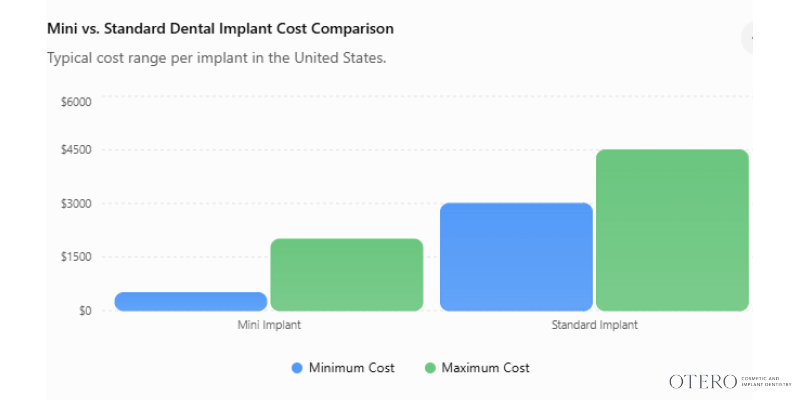
Mini implants cost much less at the start. In many cases, a single mini dental implant cost ranges from $500 to $2,000, while a standard dental implant cost often falls between $3,000 and $4,500 per tooth.
That difference can feel huge if you need several teeth replaced.
Mini implants usually require a simpler procedure. Your dentist can often place them in one visit, which lowers surgical fees and office time.
Standard implants often involve more steps, which increases your total implant cost.
If you want the lowest upfront price, mini implants often win. If you focus on strength and long-term support, regular implants may justify their higher cost.
Factors That Influence Implant Cost
Your final dental implant cost depends on more than implant type.
Key cost factors include:
- Number of teeth replaced
- Bone density in your jaw
- Need for bone grafting
- Type of restoration (crown, bridge, or denture)
- Dentist’s training and location
Standard implants often require strong bone. If your jawbone is thin, you may need a graft. That adds time and money.
Mini implants work well when bone is limited. They are thinner, so they often avoid grafting. That can reduce both surgical steps and healing time.
The size difference between mini vs regular implants also affects planning and materials. Larger implants may cost more, but they may also handle stronger biting forces.
Longevity and Replacement Needs
You should also think about how long your implant will last.
Standard implants have a long track record. With good care, many last decades. They fuse with your jawbone and support single crowns or full bridges.
Mini implants can last many years, especially when they stabilize dentures. However, they are narrower. That smaller size can mean more wear under heavy pressure.
If a mini implant fails, replacement adds new costs. Paying less today could mean paying again later.
You need to balance mini implants cost with expected lifespan. A higher upfront dental implant cost may reduce the chance of future replacement and extra procedures.
Choosing the Best Option: Personal Factors and Dentist Guidance
Your health, finances, and dental exam results shape the choice between mini vs regular implants. You need a solution that fits your body, your budget, and your long-term goals.
Patient Health and Medical Conditions
Your medical history plays a direct role in implant success. Some health issues slow healing or raise the risk of infection.
If you have uncontrolled diabetes, immune disorders, or active gum disease, your dentist may delay dental implants until your condition is stable.
Smoking also lowers success rates because it reduces blood flow to the gums.
Bone density matters too. Regular dental implants usually need enough strong jawbone to hold a wider post. If your bone is thin, you may need grafting.
Mini dental implants are narrower, often under 3 mm in diameter. Because they are smaller, they can work in areas with less bone. That may help you avoid graft surgery.
Your age also counts. Younger patients often choose regular implants for long-term strength. Older adults who want a simpler procedure may prefer mini dental implants.
Budget and Financing
Cost often shapes your decision. Regular dental implants usually cost more per tooth than mini dental implants.
Mini implants often range from about $500 to $1,500 per implant, while regular implants can cost several thousand dollars per tooth. However, mini implants may require more units to support a denture.
You should ask for a written treatment plan that shows:
- Number of implants
- Type of restoration
- Surgery fees
- Follow-up visits
Many offices offer payment plans or third-party financing. Dental insurance may cover part of the crown but not the implant itself.
Think about long-term value, not just upfront cost. Regular implants often last longer, which may lower future replacement expenses.
Clinical Assessment and Decision-Making

Your dentist uses exams and imaging to guide the final choice. A visual exam alone is not enough.
Most providers take digital X-rays or 3D scans to measure bone height and width. These scans show where nerves and sinuses sit. That helps prevent complications.
During your consultation, your dentist will review:
- Jawbone volume
- Location of the missing tooth
- Bite force and grinding habits
- Number of teeth being replaced
Mini dental implants often work well for stabilizing lower dentures or replacing small front teeth. Regular dental implants usually handle molars better because they support stronger chewing forces.
You should ask why one option fits your case better. A clear explanation helps you feel confident in your decision.
Frequently Asked Questions
Mini and standard implants differ in strength, lifespan, cost, and who qualifies for treatment. Your bone width, bite force, and long-term goals shape the right choice.
How do mini dental implants compare to standard implants in terms of stability and long-term durability?
Standard implants measure about 3.5 to 6 mm wide. Their wider body gives them more surface area to bond with your bone.
That larger contact area helps them handle strong bite forces, especially in the back molar region. Many studies report long-term success rates above 95% at 10 years for standard implants when placed correctly.
Mini implants measure about 1.8 to 3 mm wide. They work well for lighter loads, such as stabilizing lower dentures or replacing small front teeth.
Because they are narrower, they do not spread force as widely as standard implants. In the right case, they can last 10 to 15 years or longer, but they are not the first choice for heavy chewing areas.
What are the main disadvantages or risks of choosing mini dental implants instead of regular implants?
Mini implants have a smaller diameter. That means they carry less biting force than standard implants.
If you place a single mini implant in a molar area, it may face higher stress over time. That can increase the risk of loosening or fracture in high-pressure zones.
Mini implants also come as a one-piece design in most cases. This limits some flexibility in adjusting angles compared to two-piece standard systems.
You should also know that not every case suits mini implants. If you need a fixed bridge that replaces several teeth under strong bite pressure, standard implants often provide better long-term support.
How do mini dental implant costs compare with standard implants, including the total price for treatment?
Mini implants usually cost less per unit than standard implants. The surgery is often simpler and may not require bone grafting, which lowers the total bill.
Standard implants may cost more upfront. You might also need bone grafting if your jawbone is too thin, which adds to the overall treatment price.
However, total cost depends on your full plan. A case that uses several mini implants to support a denture can approach the price of fewer standard implants.
Who is a good candidate for mini dental implants, especially if you have low bone density or a thin jawbone?
You may qualify for mini implants if your jawbone is too narrow for a standard implant. They can fit in ridges as thin as about 2.5 to 3 mm in some cases.
Many dentists use mini implants to stabilize loose lower dentures. They often place them without bone grafting, which shortens treatment time.
If you have low bone density, mini implants may help you avoid more invasive surgery. Still, your dentist must check your bone quality with imaging before making a final decision.
Can mini dental implants support a full-arch or full-mouth restoration, and how does that compare to standard implants?
Mini implants often support removable overdentures. They act like anchors that snap into place and reduce movement.
They do not usually replace the need for larger implants in fixed full-arch cases. A fixed bridge that stays in your mouth and carries full chewing force often relies on standard implants.
If you want a non-removable full-arch restoration, your dentist may suggest a system built around standard implants.
What should you look for in mini dental implant reviews and before-and-after photos when choosing a provider?
Look for clear photos that show both the starting condition and the final result. The images should show gum health, alignment, and how the denture or crown fits.
Read reviews that mention follow-up care and long-term comfort, not just same-day results. You want to know how the implants performed months or years later.
Check whether the provider explains bone measurements, imaging, and why they chose mini or standard implants. A good review often includes details about planning, not just praise.