

Noticing your teeth have shifted since you had braces years ago can feel frustrating.
Yes, Six Month Smiles can often fix teeth that have moved after your first round of braces, since it’s designed to handle mild to moderate shifting in a shorter amount of time than traditional treatment.
If you’re wondering whether you can get braces again, you’re not alone. Many people need a second round of braces at some point in their lives.
Getting braces twice doesn’t mean something went wrong the first time.
If you’re considering retreatment, comparing Invisalign vs six-month smiles can help you understand which approach better fits your alignment needs, timeline, and lifestyle.
For patients who prefer a more discreet alternative to traditional metal braces, clear braces may also provide an effective way to straighten teeth that have shifted.
This guide explains what Six Month Smiles after braces can look like, from your first consultation to maintaining your results long term.
You’ll learn why your teeth may have shifted, what your retreatment options are, and how to protect your straighter smile once treatment is complete.
Key Takeaways
- Six Month Smiles can often correct teeth that have shifted since your last orthodontic treatment.
- Your consultation will help determine which retreatment option fits your specific needs.
- Wearing a retainer after treatment is key to keeping your smile straight long term.
Can Six Month Smiles Correct Teeth That Shifted After Braces?
Six Month Smiles can often fix mild orthodontic relapse, but how well it works depends on how much your teeth have moved.
Your provider will look at your specific situation to figure out if a short treatment is enough or if you need something more involved.
When Short-Term Treatment May Be a Good Fit
If your teeth have shifted just a little since you finished braces, Six Month Smiles could be a good option for you.
This treatment works best when you have mild crowding or small gaps in your front teeth, the ones people see most when you smile.
Six Month Smiles uses clear brackets and tooth-colored wires to gently guide your teeth back into place. Since it focuses on cosmetic alignment rather than fixing your bite, it’s designed for smaller adjustments.
Your treatment time depends on how much movement needs to happen, but many patients see results in about six months.
This makes it a good choice if you want straight teeth again without a long treatment process.
When Comprehensive Orthodontics May Be Needed
If your teeth have shifted a lot, or if your bite has changed too, Six Month Smiles may not be enough to fix the problem. Bigger shifts often need full orthodontic treatment with traditional braces or clear aligners.
This is especially true if you have crowding or spacing issues that go beyond your front teeth.
Your back teeth and bite alignment matter too, and Six Month Smiles doesn’t typically address those areas.
In some cases, teeth that have moved significantly may need a full round of treatment to correct properly.
Your provider can check your bite, look at how your teeth line up, and help you figure out which option will actually solve the problem instead of just covering it up.
Why Teeth Move After Earlier Orthodontic Treatment
Your teeth are not permanently locked in place after braces come off.
They can shift for a few reasons, including how well you kept up with your retainer and changes that naturally happen in your mouth over time.

Retainer Wear and Long-Term Retention
If you stopped wearing your retainer, this is likely the biggest reason your teeth moved.
Your teeth sit in a bone socket held by ligaments, and these ligaments can pull your teeth back toward their old spots if nothing holds them steady.
This process is often called orthodontic relapse, and it’s common among people who skip retainer wear.
Retention is meant to be a long-term habit, not something you do for just a few months after treatment. Removable retainers only work if you actually wear them as directed.
Here’s what typically causes retainer-related shifting:
- Wearing your retainer less often than instructed
- Losing or damaging your retainer and waiting to replace it
- Switching from full-time to nighttime wear too soon
- Outgrowing an old retainer that no longer fits your mouth
Natural Changes, Oral Habits, and Dental Conditions
Even with good retainer habits, your mouth keeps changing throughout your life. Wisdom teeth coming in can crowd your other teeth and push them out of alignment.
Your jawbone density also changes with age, which can affect how firmly your teeth are held in place.
Gum disease and other gum issues can weaken the tissue and bone supporting your teeth, making shifting more likely.
Oral habits play a role too. Tongue thrusting and teeth grinding both put ongoing pressure on your teeth, similar to the natural drift caused by everyday biting and chewing forces.
Over time, these habits and conditions add up, gradually undoing the position your teeth were once moved into.
What Happens During a Re-Treatment Consultation
Your first visit with an experienced provider sets the stage for your whole treatment plan.
Your provider will check your oral health, talk about what you want to fix, and take the records needed to map out your path forward.
Checking Oral Health and Reviewing Your Goals
Before your dentist talks about brackets or wires, they’ll want to know how your mouth is doing overall. This means checking for cavities, signs of gum disease, and any lingering gum issues from your first round of braces.
They’ll also ask about jaw discomfort or clicking near your temporomandibular joint, since TMJ problems can affect how your teeth should move this time around.
If you have any active dental issues, you may need to treat those first.
Once your mouth gets a clean bill of health, the conversation shifts to you. Your dentist will ask what bothers you most about your smile now, whether it’s a shifted tooth, a new gap, or just wanting things tighter than before.
Be honest here. Your goals shape everything that comes next in your orthodontic care.
Records, X-Rays, and Treatment Planning
Once your health check and goals are clear, your provider will gather updated records. This typically includes fresh x-rays, photos of your teeth and bite, and sometimes digital scans or impressions.
These records matter more the second time around. Your teeth may have shifted in ways that aren’t obvious just from looking, so x-rays help spot changes below the gumline or in the roots.
Your dentist uses this information to build a plan tailored to your current needs, not your old one. They’ll figure out which teeth need to move, how far, and roughly how long your retreatment should take.
Most patients leave this visit with a clear timeline and a good idea of what their new treatment will involve.
Six Month Smiles Options for a Second Round of Treatment
If your teeth have shifted after braces, you have more than one path back to a straight smile.
Your dentist can help you pick between clear aligners, clear braces with brackets and wires, or other options based on how much your teeth moved.
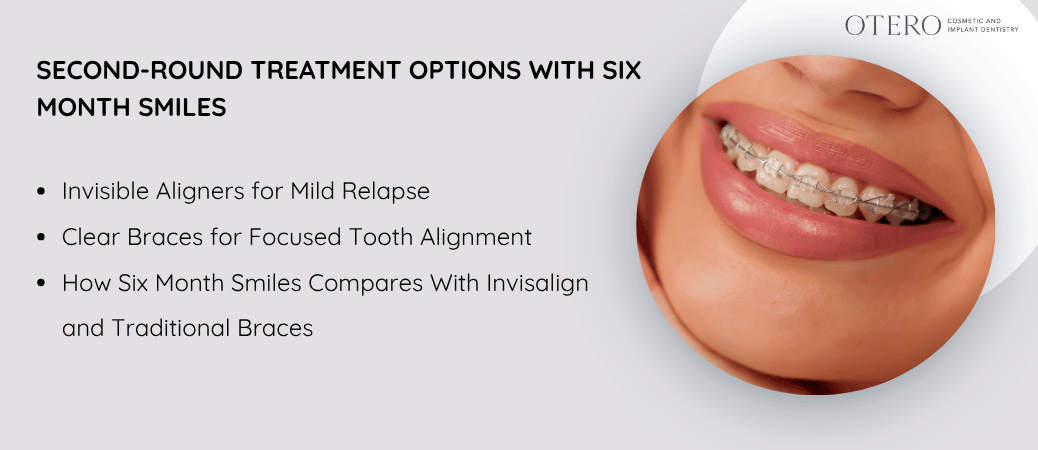
Invisible Aligners for Mild Relapse
If your teeth only shifted a little bit, invisible aligners might be all you need. These clear aligners fit over your teeth like a mouth guard and slowly push them back into place.
Six Month Smiles offers this option through dentists who are trained in the system. You wear each aligner for about two weeks before switching to the next one in the series.
Most people wear these for 22 hours a day. You take them out to eat, drink, and brush your teeth.
This option works best for small gaps or slight crowding. It won’t fix bigger problems like a shifted bite.
Clear Braces for Focused Tooth Alignment
If your relapse is more noticeable, clear braces might work better than aligners. Six Month Smiles clear braces use tooth colored brackets and wires that blend in with your teeth.
Unlike traditional metal braces, these clear braces focus mostly on your front teeth. This makes them a good fit if your back teeth still line up fine but your front smile line has moved.
The treatment plan is built around fixing specific spots rather than moving every tooth in your mouth. Your dentist will use x-rays and photos to map out exactly which teeth need to move and how far.
Clear brackets are less noticeable than metal ones. Many adults choose this option because it fits into work and social settings without drawing much attention.
How Six Month Smiles Compares With Invisalign and Traditional Braces
Each option has trade-offs worth knowing before you pick one.
| Treatment | Average Time | Best For |
| Six Month Smiles | 4–9 months | Minor relapse, front teeth only |
| Invisalign | 6–18 months | Mild to moderate misalignment |
| Traditional metal braces | 18–24 months | Complex or severe cases |
| Ceramic braces | 18–24 months | Complex cases, less visible than metal |
Six Month Smiles tends to cost less and take less time than Invisalign or traditional braces. But it only treats the teeth people see when you smile.
If your bite shifted or your back teeth moved, traditional metal braces or Invisalign may work better since they treat your whole mouth.
Your Six Month Smiles provider can tell you during your consultation which option fits your specific case.
How Clear-Braces Re-Treatment Works
If you already had braces once, going through treatment again with Six Month Smiles clear braces follows a clear step-by-step path built around planning, custom trays, and short visits.
You will notice the brackets and wires feel different from your first time, and the whole process moves faster than traditional metal braces.
Planning and the Braces-On Appointment
Before your braces go on, your dentist takes new records. This includes X-rays, impressions, and photos of your teeth.
These records get sent in so a team can build your treatment plan. You will also see a 3D simulation of how your smile should look when treatment ends.
Once you approve the plan, a lab makes your custom indirect bonding trays with brackets already placed inside.
Everything you need comes packed into a patient tray kit, so your braces-on appointment stays quick and simple.
At this visit, your dentist uses the tray to bond all your brackets at once. This saves time compared to placing each bracket by hand.
Brackets, Tooth-Colored Wires, and Adjustment Visits
Your new brackets are made from clear material, so they blend in with your teeth. This makes them a good fit if you want a more discreet second round of treatment.
The wires used are tooth-colored and made from shape memory metal. These wires apply gentle, steady pressure to move your teeth into place without needing constant bending or adjusting by hand.
Quick ties hold the wires onto your brackets. They make each adjustment visit faster since your dentist can swap wires with less effort.
You will return about every four weeks for adjustments. At each visit, your dentist checks your tooth movement and updates your wires if needed.
Typical Timing and the Role of IPR
Most re-treatment cases with Six Month Smiles wrap up in about six months, though this can vary based on how your teeth shifted after your first round of braces.
Your dentist will give you a more exact timeline once your plan is set.
Interproximal reduction, or IPR, may come up during your visits. This involves lightly filing small amounts of enamel between certain teeth to create room for movement.
The wide arch shape used in these wires often reduces how much IPR you actually need. If your dentist does recommend it, the process is quick and doesn’t require numbing.
Because your teeth already moved once before, your case may need less overall adjustment than a first-time patient. This is part of why treatment times often stay short for re-treatment cases.
Keeping Your Smile Straight After Re-Treatment
Once your Six Month Smiles re-treatment is done, your job isn’t over yet. You need a good retention plan and quick action on any new dental issues to protect your straight smile for good.

Choosing and Wearing a Retainer
Your retainer is the most important part of keeping your new smile in place. Without one, teeth can shift back toward their old spots, sometimes fast.
You’ll likely get removable retainers to wear on a schedule set by your dentist. Most people wear them full-time at first, then switch to nights only.
Here’s what to keep in mind:
- Wear it as directed. Skipping days can lead to orthodontic relapse.
- Clean it daily. This stops bacteria buildup and keeps it fitting well.
- Replace it if damaged. A cracked or loose retainer won’t hold your teeth in place.
- Bring it to checkups. Your dentist can check the fit and make adjustments if needed.
Since you’ve already had teeth shift once, staying consistent with your retainer matters even more this time around.
Protecting Oral Health and Addressing New Changes Early
Good oral health habits support your retention plan. Brush and floss daily to lower your risk of cavities and gum disease, since both can weaken the structures holding your teeth in place.
If you grind your teeth at night, ask your dentist about a nightguard. Teeth grinding puts extra pressure on your smile and can undo your results over time.
See your dentist every six months for professional cleanings. These visits help catch small problems, like early gum disease or a shifting tooth, before they turn into bigger ones.
If you notice any changes, don’t wait. Contact your provider right away. Catching movement early usually means an easier fix and a better chance of keeping your straight smile long-term.
Frequently Asked Questions
Getting braces again brings up a lot of questions, especially about cost, timing, and whether Six Month Smiles can handle your specific situation. Here are answers to the questions people ask most about this option.
Can Six Month Smiles fix teeth that have shifted after braces?
Yes, in most cases it can. Six Month Smiles is designed to fix mild to moderate crowding and spacing, which is exactly what happens when teeth shift back after you stop wearing your retainer.
This type of shifting is called relapse, and it’s actually one of the most common reasons people come back for a second round of treatment.
If your teeth have moved just a little, this system can often move them back into place without a long treatment plan.
Your dentist will need to check how much your teeth have shifted first. If the movement is more than mild to moderate, you may need a different type of treatment instead.
What does re-treatment with Six Month Smiles involve?
Your dentist will start with x-rays, photos, and impressions or a digital scan of your teeth. This information gets used to create a treatment plan just for you.
Once the plan is ready, you’ll come in for your braces or aligners to be fitted. If you’re using clear braces, you’ll wear them for several months with checkups every few weeks.
If you’re using aligners, you’ll switch to a new tray about every two weeks.
Many people who have had braces before are actually good candidates for this treatment.
That’s because your teeth have already been through orthodontic work, so a second round is often used to fix small changes rather than start from scratch.
How much does Six Month Smiles cost for someone who has had braces before?
Cost varies depending on your dentist, your location, and how much work your teeth need. In general, this treatment tends to cost less than full braces or Invisalign because the treatment time is shorter.
Some dental offices offer monthly payment plans to help spread out the cost.
It’s a good idea to ask your dentist for an exact price during your consultation, since costs can differ quite a bit from one practice to another.
Is Six Month Smiles better than Invisalign for correcting a minor orthodontic relapse?
Both options can work well for minor relapse, but they’re not exactly the same.
Six Month Smiles clear braces are fixed to your teeth, which some people find gives more consistent results since you don’t have to remember to wear them.
Invisalign, on the other hand, uses removable aligners you take out to eat and brush your teeth.
If you liked wearing aligners the first time and know you’ll stick with wearing them consistently, that might be the better fit.
Neither option is universally “better.” The right choice really depends on your daily habits, your budget, and what your dentist recommends after checking your teeth.
How long do Six Month Smiles results usually take after previous braces?
Most cases take between six and ten months. Since your teeth have already been through orthodontic treatment before, your case may move even faster if the shifting is minor.
Treatment length also depends on how much correction your teeth need now. A small amount of relapse usually takes less time to fix than a case with more crowding or spacing.
Is Six Month Smiles worth it for straightening only the front teeth?
If your main concern is just your front teeth, this treatment can be a good match.
Six Month Smiles was actually built with this kind of cosmetic fix in mind, since it focuses on the teeth people see most when you smile.
Keep in mind that fixing only the front teeth won’t change your bite or jaw alignment. If those are also a concern, you’ll want to talk to your dentist about whether a different treatment might serve you better.