

When a dental implant fails, the bone around it doesn’t just stay the same. Some of that jawbone may thin out or shrink, especially if infection or long-term pressure was part of the problem.
The good news is that most people can get another implant, because a failed dental implant can usually be removed under local anesthetic, and a new implant can often be placed once your bone and gums have healed.
Healing usually takes a few months, and if you lost bone, a graft can rebuild the site first.
Understanding failed dental due to implant bone loss can help you see why early treatment matters.
How much bone you still have, why the implant failed, and how quickly you get checked all shape your options, including whether the implant can be saved or needs to be replaced.
Below, you’ll see what happens to bone under a failing implant, the warning signs worth a same-week phone call, and how a second attempt is planned to last.
Key Takeaways
- A failing implant can lead to bone loss in your jaw, so early care protects the site.
- Pain, looseness, swelling, or discharge around an implant needs a prompt dental exam.
- Most failed implants can be replaced after healing, sometimes with a bone graft first.
How Implant Failure Affects the Jawbone
When an implant stops holding steady, the bone around it changes.
Some of that bone shrinks away, and the amount you lose depends on how long the problem goes untreated and what caused it in the first place.
Why Stable Bone Is Essential for Osseointegration
Osseointegration is the process where your jawbone grows tightly against the surface of the implant fixture. This healing process takes several months.
When there is not enough bone to support an implant, bone grafting for a full mouth dental implant may be recommended to rebuild the site before implant placement.
For that bond to form, the bone needs enough thickness and good bone density. The implant also has to stay still while it heals.
Failure starts when the connection between bone and implant surface never forms correctly or breaks down later.
Poor bone quality, insufficient bone density, or too much pressure during healing can all interrupt it.
Think of it like a fence post in soft soil. Even a perfect post will wobble if what surrounds it can’t grip.
Bone Resorption After an Implant Loses Support
Once an implant loses its bond with the jawbone and becomes mobile, your body starts breaking down the bone around it. This is called bone resorption.
Instead of gripping the fixture, the bone pulls back. A layer of soft tissue often forms in the gap.
Every time you chew, the loose implant shifts slightly. That movement irritates the bone and speeds up the loss.
This is why implant loosening should never be ignored. A few weeks of implant mobility can cost you bone that took years to build, and more bone loss usually means more rebuilding work later.
When Bone Loss Is Mild, Moderate, or Advanced
Your dentist measures bone loss with X-rays or a 3D scan. The amount changes what happens next.
| Level | What it looks like | Typical next step |
| Mild | Small dip in bone around the implant neck, no mobility | Deep cleaning of the implant, treat the cause |
| Moderate | Noticeable bone loss on the scan, some looseness | Remove the implant, then a bone graft |
| Advanced | Large defect, clear implant instability, possible gum recession | Remove the implant, graft, and wait 4–6 months |
Early failure within the first few months is often linked to infection or weak bone. Later failure tends to build slowly, so it may be caught at a routine checkup.
How Gum Inflammation Can Progress to Bone Damage
Trouble often starts in the gums, not the bone. Peri-implant mucositis is red, puffy, tender tissue around the implant. At this stage, the bone is still fine.
If plaque and bacteria stay under the gumline, that peri-implant inflammation moves deeper. It becomes peri-implantitis, which does destroy bone.
Watch for these signs and get them checked early:
- Bleeding when you brush or floss
- Pus or a bad taste near the implant
- Gum recession that exposes metal
- Aching or pressure when you chew
Mucositis usually clears up with professional cleaning and better home care. Peri-implantitis rarely reverses on its own, and the bone it takes doesn’t grow back without a graft.
Warning Signs That Need Prompt Dental Care
Bone loss under an implant usually starts quietly, but your body still gives you clues.
Pain that won’t quit, bleeding gums, a wobbly implant, drainage, or a bite that suddenly feels off are all reasons to call your dentist this week, not next year.
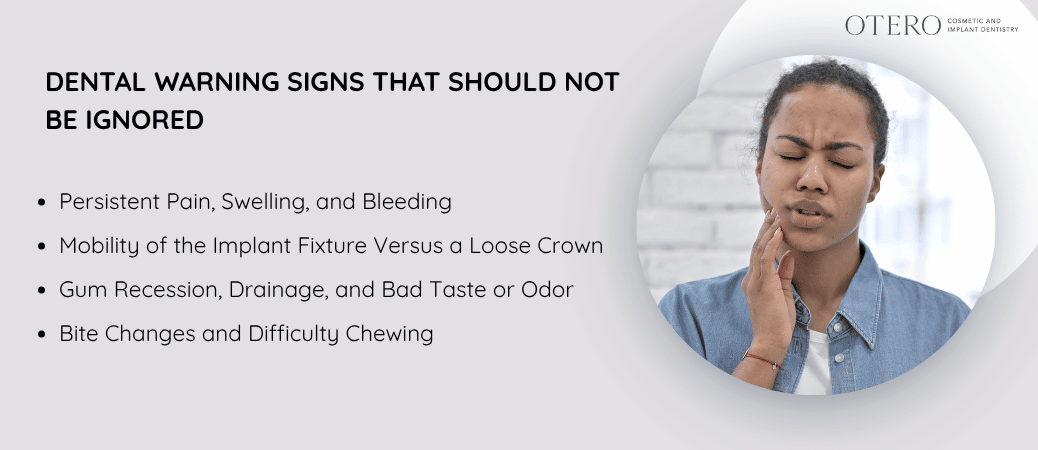
Persistent Pain, Swelling, and Bleeding
Some soreness for a few days after surgery is normal. Pain that grows worse after the first week is not.
Watch for these signs:
- Throbbing or aching around the implant that pain relievers barely touch
- Swollen gums that stay puffy or red for more than a week
- Gum bleeding when you brush, floss, or eat
- Tenderness when you press on the gum near the implant
These are common signs of a failed dental implant and often point to peri-implantitis, an infection that eats away at the bone holding the post in place.
The sooner your dentist cleans out that infection, the more bone you keep, and the better your odds of getting a replacement implant later.
Mobility of the Implant Fixture Versus a Loose Crown
If something feels loose, figure out what is loose. It matters a lot.
A loose implant crown or a loose abutment screw is a repair. Your dentist can often tighten or re-cement the crown in one short visit, and the bone stays healthy.
A loose implant fixture, the titanium post inside your bone, is a different story. That movement means the bone never fused to the implant or has been lost around it, and the implant usually has to come out.
You can’t always tell the difference at home. Try this: if the tooth twists or rocks but the gum stays still, it’s likely the crown.
If the whole thing shifts as one unit, treat it as implant mobility and get seen quickly.
Gum Recession, Drainage, and Bad Taste or Odor
Look in the mirror. Is more of the metal post showing than it used to?
Gum recession around an implant often means the bone underneath has shrunk back, because gum tissue needs bone for support. A gray or dark line at the gumline is another hint.
Other red flags:
| What you notice | What it may mean |
| Pus or fluid at the gumline | Active infection in the tissue and bone |
| Bad taste or odor that returns after brushing | Bacteria trapped in a deep pocket |
| Gum that pulls away from the implant | Bone loss and a widening gap |
A steady bad taste plus drainage is one of the clearer warning signs of implant failure, so don’t try to rinse it away for weeks on your own.
Bite Changes and Difficulty Chewing
Your bite is a good early alarm system. You notice small changes fast because you eat every day.
Call your dentist if you feel:
- The implant tooth hitting first when you close your teeth
- Difficulty chewing on that side, or a need to switch food to the other side
- Pressure, clicking, or a shifting feeling while you bite down
- Jaw soreness that started around the same time
Uneven bite force can overload one implant and speed up bone loss around it. Sometimes the fix is simple, your dentist adjusts the crown so the pressure spreads out evenly.
Ignoring it is the risk. Repeated overloading can lead to more bone loss and a harder time placing a future implant, which may mean bone grafting before you try again.
Why Implants Fail Early or Years Later
Implant failure usually falls into two groups: problems that show up during the first few months of healing and problems that appear five, ten, or fifteen years down the road.
Understanding dental implant failure rates and when failures tend to occur can help explain how much bone may have been lost and what your options look like for a replacement.
Early Healing Problems and Failed Osseointegration
If that bond does not form successfully, understanding your options forreplacement after failure can help you prepare for the next steps, including healing, bone rebuilding, and possible implant replacement.
this window, the titanium post is supposed to fuse with your jawbone in a process called osseointegration.
When that fusion doesn’t happen, the implant stays loose and never becomes stable.
Common reasons include infection at the surgical site, poor bone quality, insufficient bone density, and micro-movements from putting a crown on too soon.
The good news? Early failure often means less bone damage. The implant simply never bonded, so it can usually be removed more easily.
If a nearby damaged or infected tooth also needs attention, tooth extraction may be recommended as part of the treatment plan before the area is prepared for future implant placement.
Late Infection and Progressive Peri-Implantitis
Late implant failure is a different story. The most common cause is peri-implantitis, an infection of the gum and bone around an implant that already integrated successfully.
It starts quietly. Plaque builds up along the implant, the gums get inflamed, and then the bone underneath begins to shrink away. Bone loss can continue for years before the implant feels loose.
Risk factors include poor oral hygiene, a history of gum disease, and skipping regular cleanings.
Because this type of failure eats away at bone over time, you’re more likely to need grafting before a second implant.
Watch for these warning signs of implant infection:
- Red, puffy, or bleeding gums around the implant
- Gum recession that exposes the metal
- Pus or a bad taste near the site
- Deep aching or pressure when you bite
- An implant that shifts or wobbles
Bite Stress, Bruxism, and Mechanical Complications
Your implant doesn’t have a natural ligament to cushion pressure the way a real tooth root does. Force transfers straight into the bone.
That’s why bruxism matters so much. Nighttime teeth grinding and daytime clenching can put far more load on an implant than normal chewing, and over time that bite stress causes bone to thin at the neck of the implant.
Mechanical complications add to the problem. Screws loosen, crowns crack, and abutments fracture, which lets bacteria seep in and speeds up bone loss.
Too few implants supporting a bridge creates the same issue. Spreading the load across enough posts helps prevent excessive stress that leads to failure.
Health, Lifestyle, and Surgical Risk Factors
Some risks come from your body and habits rather than the implant itself.
Smoking limits blood flow to your gums and slows healing. Studies have found failure rates in smokers reaching up to 20 percent.
Uncontrolled diabetes, osteoporosis, autoimmune diseases like rheumatoid arthritis, and cancer treatment such as radiation to the jaw all interfere with bone healing and repair.
Surgical factors matter too. An implant placed at the wrong angle, positioned too close to a nerve, or set into bone that was never thick enough is more likely to run into long-term problems.
| Risk Factor | How It Affects Bone |
| Smoking | Reduced blood supply, slower healing |
| Uncontrolled diabetes | Delayed bone formation, higher infection risk |
| Osteoporosis | Lower bone density and weaker support |
| Radiation to the jaw | Reduced bone repair capacity |
| Poor implant angle | Uneven force and localized bone loss |
Diagnosis and Treatment to Protect the Site
Before anyone talks about a new implant, your dentist needs to know how much bone is left and whether infection is still active.
That answer comes from a hands-on exam, 3D images, and treatment that either calms the tissue down or clears the site for a fresh start.
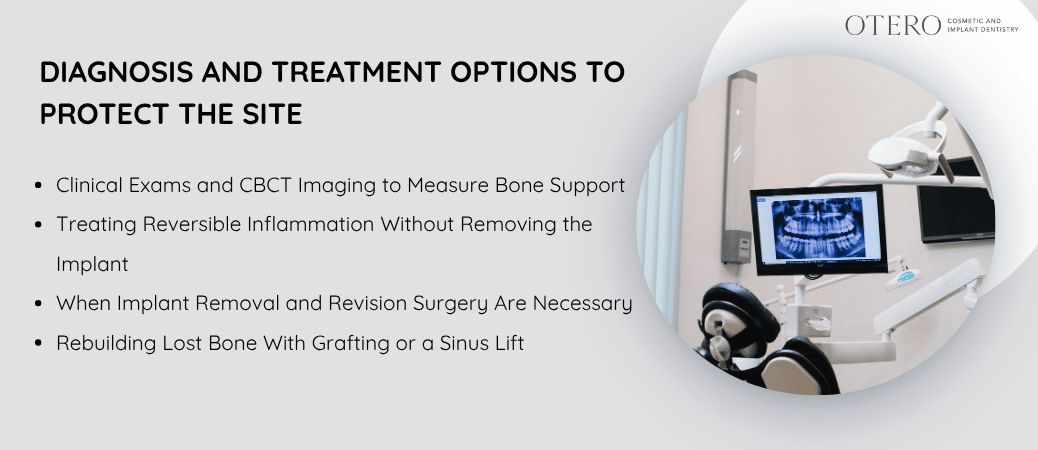
Clinical Exams and CBCT Imaging to Measure Bone Support
Your implant dentist or prosthodontist starts by checking the basics: bleeding, swelling, pus, pocket depth around the implant, and any movement when pressure is applied.
Movement is a big deal. A stable implant does not wiggle, so looseness usually means the bond with bone is gone.
Next comes imaging. A regular X-ray shows bone height, but CBCT imaging gives a 3D view of the site, so your dentist can see bone width, bone density, and how close the defect sits to the sinus or nerve.
These imaging tests and probing measurements also give a baseline. Losing about 0.5 to 1.0 mm of bone in the first year is normal remodeling, but steady loss after that points to a real problem.
Treating Reversible Inflammation Without Removing the Implant
If the trouble is still in the gum tissue, the outlook is good. Peri-implant mucositis means the soft tissue is inflamed but the bone is intact, and that stage can often be reversed.
Common first steps include:
- Deep cleaning around the implant to remove plaque and hard buildup
- Antimicrobial therapy, such as local antibiotics placed in the pocket
- Antiseptic rinses like chlorhexidine for short-term home use
- Laser therapy in some offices to reduce bacteria in the pocket
- Flap surgery when the dentist needs direct access to clean the implant surface
Non-surgical care usually means only a few tender days. After treatment, expect a recheck in about four to six weeks and cleanings every three to four months during the first year, since peri-implantitis can come back.
When Implant Removal and Revision Surgery Are Necessary
Sometimes saving the implant is not the best move. If the implant is loose, if a large share of the supporting bone is gone, or if infection keeps returning, removal protects what bone you still have.
Removal is often simpler than people expect, because a failed implant is no longer locked into bone. Your dentist cleans out infected tissue, smooths the socket, and lets the site heal.
Revision surgery matters most when the original implant sat at a bad angle or partly outside the bone. That kind of poor placement can damage bone, so the plan has to fix the site before another implant goes in.
Rebuilding Lost Bone With Grafting or a Sinus Lift
Once the site is clean, bone grafting can rebuild the ridge. Your dentist packs graft material into the defect, covers it with a membrane, and waits while your body replaces it with your own bone.
Healing usually takes three to six months, and sometimes longer for larger defects.
In the upper back jaw, a sinus lift raises the sinus floor to create height for an implant. Small lifts can happen at the same visit as placement, while bigger ones need their own healing period.
Implant replacement is planned only after imaging confirms enough bone volume and density, which is why a failed implant can often be replaced once the site has fully healed.
Planning a Safe Replacement Implant
Getting a second implant works best when you give the bone time to heal, rebuild any missing volume, and fix whatever caused the first failure.
Your timeline, costs, and the type of restoration you end up with all depend on how much healthy bone you have left.
Healing Time and Readiness for New Implant Placement
Timing is not the same for everyone. If the implant came loose early, there is no infection, and the bone walls are still solid, your dentist may be able to place a new implant during the same visit.
That is not the usual path, though. When infection or bone loss is involved, the site normally needs three to six months to heal before anything new goes in.
Peri-implantitis cases almost always need healing time and bone regeneration first, since the inflammation destroys bone around the implant.
Your dentist will confirm readiness with CBCT imaging, which shows bone height, width, and density in 3D.
Bringing your old surgical notes and X-rays helps too, because knowing what happened the first time makes the second attempt safer.
How Bone Grafting Supports a Second Implant
A replacement implant needs enough bone to grip. When the failed implant took bone with it, grafting rebuilds that foundation.
Your options depend on the size of the defect:
| Type of graft | When it is used | Typical healing |
| Socket graft | Filling the space right after removal | 3–4 months |
| Ridge augmentation | Rebuilding width or height | 4–9 months |
| Sinus lift | Upper back teeth with thin bone below the sinus | 6–9 months |
Graft material can come from your own body, a donor, an animal source, or a synthetic product. All work by giving your bone a scaffold to grow into.
Careful grafting paired with digital planning and surgical guides can often rescue a damaged site for a new implant.
Choosing the Right Restoration and Managing Bite Forces
Bone is only part of the story. If too much pressure broke down the first implant, the new one needs a smarter design.
Your dentist may pick a wider or longer implant, change the angle, or add a second implant to share the load.
For several missing teeth, a bridge or full-arch restoration can spread force more evenly than separate crowns.
The implant crown itself matters. A slightly shorter crown, a flatter chewing surface, and a careful bite adjustment all reduce strain.
If you grind or clench, that habit has to be addressed. A custom night guard protects the implant crown while you sleep, and treating bruxism is one of the steps that helps a revision case succeed long term.
Cost, Financing Options, and Specialist Care
Replacing a failed implant can involve several stages, including implant removal, bone grafting, placement of a new implant, and a new crown.
Your total cost depends on how much bone has been lost and which procedures are needed to rebuild the site.
At Otero Cosmetic & Implant Dentistry, your treatment plan can be broken down by stage so you understand the expected costs before moving forward.
Ask about available financing options that may help make treatment expenses more manageable.
Complex revision cases also require careful planning. Dr. Misael Otero can evaluate the remaining bone, identify factors that may have contributed to the original failure, and determine whether grafting or other treatment is needed before another implant is placed.
Long-Term Habits That Help Preserve Bone and Implants
Once a new implant is in place, the bone around it depends on what you do every day, how well you clean it, how often you get it checked, and how healthy the rest of your body stays.
The habits below protect that bone and lower your risk of losing another implant.

Daily Plaque Control Around Implant Restorations
Plaque is the main thing that leads to bone loss around an implant. When bacteria sit along the gum line, your body reacts with inflammation, and that inflammation eats away at bone.
Brush twice a day with a soft-bristle brush, tilted about 45 degrees toward the gums. Hard bristles can scratch the crown and give bacteria more places to hide.
Add these tools to your routine:
- Interdental brushes: Pick wire-free ones so metal doesn’t scratch the titanium
- End-tuft brushes: Great for the tongue side of back implants
- Water flosser: Start on a low setting to protect the seal of tissue around the implant
For string floss, wrap it around the implant post and use a back-and-forth shoe-shine motion instead of snapping it up and down.
Regular Checkups for Early Detection
Bone loss usually starts quietly. You often won’t feel pain or notice looseness until a lot of damage is already done.
That’s why six-month checkups matter so much. Your dentist can spot early gum disease and peri-implant inflammation before it reaches the bone.
Plan on X-rays about once a year. These images get compared to the ones taken when your implant was placed, so any drop in bone height shows up clearly.
Cleanings around implants are different, too. Your hygienist should use resin or carbon fiber instruments, not steel scalers.
Your dentist will also check your bite. A small bite adjustment can take pressure off an implant that’s carrying too much force.
Quitting Smoking and Managing Health Conditions
Smoking narrows blood vessels and cuts blood flow to your gums and jawbone. Less blood means less oxygen, slower healing, and a higher chance of infection.
Quitting smoking is one of the biggest lifestyle changes that helps implants last. If you’re not ready to quit completely, ask your dentist about cessation programs before your next implant is placed.
Health conditions matter as well:
| Condition | Why it affects bone |
| Uncontrolled diabetes | High blood sugar weakens immune response and slows healing |
| Osteoporosis | Lower bone density means less support around the implant |
| Autoimmune diseases | Medications and inflammation can affect bone healing |
Grinding is another risk. Implants have no shock absorber like natural teeth do, so a custom night guard helps spread out that force.
Post-Surgery Care During Healing
The first few weeks after placement set the stage for everything else. Bone needs time to grow tightly against the implant surface.
Following proper All-on-X aftercare instructions is especially important for patients recovering from full-arch implant treatment, including sticking to a soft food diet during the initial healing period.
Use the antiseptic rinse your surgeon prescribes, and rinse gently rather than swishing hard. Avoid straws and don’t smoke during healing.
Keep brushing your other teeth normally, since poor oral hygiene during recovery invites bacteria to the surgical site.
Go to every follow-up visit. Knowing what to expect before and after surgery makes recovery smoother and gives your replacement implant a better shot at lasting.
Frequently Asked Questions
Bone under a failed implant can be thinned by infection or poor placement, but grafting rebuilds it in most cases, and many people go on to receive a second implant after the site heals.
Below are answers about removal, waiting times, bone rebuilding options, and the warning signs worth watching for.
What happens to the jawbone when a dental implant fails?
When an implant fails, the bone around it usually pulls away or breaks down. Infection is the most common reason.
Bone loss around a dental implant often starts as gum inflammation and then moves into the bone, a stage called peri-implantitis.
A small amount of bone change is normal at first. Studies show implants lose about 0.5 to 1.0 mm of bone near the top during the first year, then settle. Loss that keeps going after that is a sign of trouble.
Angle problems can also matter. If the post was placed outside the bone or tilted the wrong way, poor surgical placement can damage bone in ways that need rebuilding before another try.
Does a failed dental implant need to be removed?
In most cases, yes. Once an implant loses its bond with the bone or becomes infected, cleaning alone will not save it. Removing the implant stops the infection and lets the tissue and bone start to heal.
Removal is usually simpler than the original surgery. A loose implant often comes out easily, and your dentist will numb the area first.
Your dentist will also clean out any infected tissue at the same visit. That step protects the bone you still have.
Can I get another dental implant after a failed one is removed?
Most people can. A failed implant can usually be replaced once the site is clean, the infection is gone, and there is enough healthy bone to hold a new post.
Success the second time depends on fixing what went wrong. Smoking, uncontrolled diabetes, grinding, and gum disease all raise the risk of a repeat failure.
Bring your old records to the consultation. Surgical notes, implant type, and past imaging help your provider figure out the cause and plan around it.
How long do I need to wait before replacing a failed implant?
It depends on how much bone is left. If the site is healthy and no graft is needed, some dentists place a new implant within a couple of months.
When grafting is needed, the wait is longer. Bone usually takes three to six months to mature enough to support a new post.
Sometimes both steps happen at once. Bone grafting can be done during implant replacement when the defect is small, which cuts down on total treatment time.
What treatment options are available if there is not enough bone for a new implant?
At Otero Cosmetic & Implant Dentistry, several treatment approaches are considered to rebuild the area:
- Bone grafting: Adds material to the site so a new implant has something solid to hold onto.
- Sinus lift: Raises the sinus floor in the upper back jaw to make room for more bone height.
- Ridge augmentation: Widens or builds up a jaw ridge that has flattened out.
- Gum tissue grafting: Repairs thin or damaged gums so they can seal around the new implant.
- Guided surgery: Uses 3D scans and a surgical guide to place the implant exactly where the best bone is.
Graft material can come from your own body, a donor, an animal source, or a synthetic product. Your provider will pick one based on how much bone you need and where it is missing.
Shorter or narrower implants are another option. In some cases, they let you avoid a large graft entirely.
What are the common signs that a dental implant may be failing?
Early problems often cause no pain at all, which is why checkups matter. Still, there are warning signs worth reporting to your dentist right away.
Watch for:
- The implant or crown feeling loose or shifting when you bite
- Gums that bleed, swell, or stay red around the implant
- Pus or a bad taste coming from the site
- Aching pain that starts months or years after healing
- Gums pulling back so the metal post shows
- Trouble chewing on that side
Do not wait it out. Catching implant complications early gives you a better chance of saving the implant and the bone around it.