

Executive summary
Understanding chronic disease and tooth loss in U.S. adults requires looking at several overlapping factors, including dental caries, periodontitis, smoking, age, access to care, and chronic health conditions.
The latest nationally published clinical-examination data, from the 2017–March 2020 National Health and Nutrition Examination Survey, show complete tooth loss, edentulism, in 1.2% of adults aged 35–49, 5.9% aged 50–64, 11.4% aged 65–74 and 19.7% aged 75 or older.
Among adults aged 65 or older, prevalence was 15.2% overall, 21.8% in non-Hispanic Black adults, 29.8% among those in poverty, 33.4% among those with less than secondary-school education and 29.4% among current smokers.
Sex differences were small overall: 15.7% in men and 14.7% in women.
The strongest comparable U.S. estimates come from a 2022 analysis of 471,107 Behavioral Risk Factor Surveillance System respondents.
After adjustment for age, sex, race, education, income, smoking, body mass index and dental care, edentulism was associated most strongly with chronic obstructive pulmonary disease, or COPD, adjusted relative-risk ratio 2.18; diabetes, 1.49; arthritis, 1.49; cardiovascular disease, 1.38; stroke, 1.31; kidney disease, 1.16; and cancer, 1.05. Multimorbidity was associated with a twofold risk of edentulism.
These estimates demonstrate clustering, not causation: the data were cross-sectional, self-reported and collected in 2012.
Causal confidence is greatest for pathways through which diabetes worsens periodontal infection and healing; Sjögren disease and medications cause salivary hypofunction; and head-and-neck cancer treatment damages salivary glands and oral tissues.
For COPD, cardiovascular disease, obesity, kidney disease and dementia, biological pathways are plausible, but age, smoking, poverty, diet, frailty, healthcare access and reverse causation account for an uncertain proportion of observed associations.
New Hanover County has no recent, directly examined county-level edentulism estimate in its principal community-health reports.
Nevertheless, its risk profile is consequential: 19.43% of residents were aged 65 or older in 2023, compared with 17.71% nationally; 29.68% of older residents lived alone; and the total population is projected to rise 16.3% between 2020 and 2030.
The county’s reported adult prevalence was 32.4% for obesity, 9.1% for diabetes, 6.2% for coronary heart disease and 2.7% for chronic kidney disease.
Heart, kidney and chronic lower-respiratory disease mortality exceeded national rates.
Under a conservative scenario in which older-adult edentulism declines by 1.5% relatively each year, prevalence would fall from 15.2% in 2020 to approximately 13.9% in 2026, 13.1% in 2030 and 11.2% in 2040.
Because the older population is expanding, however, the number needing preventive, restorative and prosthodontic care may remain stable or increase.
The aging, population growth and geographic pockets of disadvantage make rising service demand more probable than falling demand.
Methods and evidence base
A structured search prioritised U.S. federal and state surveillance, county public-health reports and original U.S.-based studies published or operational during approximately 2021–August 2026.
Sources included CDC and National Center for Health Statistics oral-health surveillance; NHANES, BRFSS and PLACES documentation; AHRQ’s Medical Expenditure Panel Survey; CMS Medicare and Medicaid materials; North Carolina DHHS; New Hanover County and Novant Health community assessments; and PubMed-indexed studies.
Older observations were retained only when necessary for longitudinal context or because a recent paper analysed an older national cohort.
Inclusion required an adult U.S. population, measured or self-reported tooth loss/edentulism, a specified chronic disease or disparity dimension, and interpretable design or effect estimate.
International studies, case reports and studies limited to periodontitis without tooth-loss outcomes were generally excluded.
“Incidence” was distinguished from prevalence: contemporary national surveys mainly provide tooth counts or cumulative loss at one point in time.
A recent nationally representative incidence series for newly lost teeth is not available; extraction incidence can be constructed from claims or longitudinal cohorts, but neither represents all U.S. adults.
National burden, incidence and disparities
The age gradient is steep and cumulative. Mean retained permanent teeth fell from 27.0 at ages 20–34 to 23.3 at 50–64, 21.7 at 65–74 and 19.8 at 75 or older.
Among older adults, mean missing teeth reached 11.2 in the high-poverty group and 10.6 among both non-Hispanic Black adults and adults without a secondary-school qualification.
| Population, 2017–March 2020 | Edentulism prevalence |
| Age 35–49 | 1.2% |
| Age 50–64 | 5.9% |
| Age 65–74 | 11.4% |
| Age ≥75 | 19.7% |
| Men ≥65 | 15.7% |
| Women ≥65 | 14.7% |
| Non-Hispanic White ≥65 | 13.9% |
| Non-Hispanic Black ≥65 | 21.8% |
| Mexican American ≥65 | 15.9% |
| High poverty ≥65 | 29.8% |
| Low poverty ≥65 | 11.8% |
| Less than secondary school ≥65 | 33.4% |
| More than secondary school ≥65 | 8.8% |
Source: CDC/NHANES. Estimates by age below 65 and estimates among adults 65 or older are drawn from related surveillance tables.
Historical improvement has been substantial: complete tooth loss among adults aged 65 or older declined from 29.9% in 1999–2000 to approximately 13% in 2017–2018.
Yet disparities narrowed much less consistently than the population average, and the Healthy People 2030 indicator for total tooth loss among adults aged 45 or older, 8.9% in 2017–2020, has shown little detectable movement towards its 6.3% target.
Race and ethnicity should not be interpreted as biological causes.
The observed gradients reflect accumulated differences in wealth, education, occupational exposure, smoking environments, fluoridation and preventive care, insurance, provider availability and histories of discrimination.
Medicare’s exclusion of routine dental treatment is particularly important after age 65; Medicaid adult dental coverage varies by state because federal law sets no minimum adult benefit.
Chronic disease associations, causality and mechanisms
The following effect estimates should not be compared as though they were trial results. Most describe associations between accumulated disease histories and accumulated tooth loss.
| Condition | U.S. effect estimate or finding | Interpretation |
| COPD | Adjusted RR for edentulism 2.18, 95% CI 2.08–2.29 | Largest comparable association; substantial confounding by smoking, poverty and healthcare utilisation |
| Diabetes | RR 1.49, 1.44–1.56 | Strong biological plausibility through hyperglycaemia, infection, impaired healing and periodontitis |
| Arthritis | RR 1.49, 1.44–1.54 | May reflect systemic inflammation, disability and impaired hygiene; not specific to autoimmune arthritis |
| Cardiovascular disease | RR 1.38, 1.30–1.45 | Shared smoking, diabetes, inflammation and socioeconomic pathways; direction may be bidirectional |
| Stroke | RR 1.31, 1.24–1.40 | Disability, dysphagia, medication and reduced self-care are plausible mediators |
| Chronic kidney disease | RR 1.16, 1.08–1.25 | Immune dysfunction, diabetes, xerostomia and access burden; modest adjusted association |
| Cancer | RR 1.05, 1.01–1.11 | Weak overall association masks stronger treatment-specific risks in head-and-neck cancer |
| Multimorbidity | RR 2.03, 1.96–2.10 | Supports cumulative biological, medication, functional and access burdens |
| Abdominal obesity | OR 1.41, 1.06–1.87 in men | NHANES association; sex-specific and susceptible to diet and metabolic confounding |
| Cognitive decline | Edentulism coefficient −0.42 cognition points, −0.56 to −0.28 | Longitudinal HRS evidence; association persists after adjustment but does not prove dementia causation |
Except for obesity and cognition, relative-risk estimates are from the same BRFSS analysis and share its limitations.
Diabetes can increase glucose in saliva, alter the oral microbiome, weaken host response and accelerate cavities and periodontal destruction; periodontitis may, in turn, worsen glycaemic control.
U.S. adults with diabetes are reported to be 40% more likely to have untreated cavities, and approximately 60% had a medical visit but no dental visit in the preceding year, illustrating both biological and care-integration pathways.
COPD, cardiovascular disease and tooth loss share tobacco exposure, chronic inflammation, low income and fragmented care.
Bronchodilators and other medications may cause dry mouth, while breathlessness can reduce tolerance of dental treatment.
Consequently, the high COPD estimate should not be treated as a wholly causal effect.
Polypharmacy, particularly anticholinergics, antidepressants, opioids, bronchodilators and some cardiovascular agents, may connect multimorbidity to caries and extraction through persistent xerostomia.
Dementia relationships are bidirectional. Tooth loss may affect mastication, diet, vascular and inflammatory pathways, but cognitive deterioration also reduces hygiene, appointment attendance and treatment tolerance.
In a nationally representative U.S. cohort of 22,728 adults over 50, edentulism predicted greater ten-year cognitive decline, whereas recent dental care was protective; 2022 BRFSS data similarly showed subjective cognitive decline increasing from 7.7% among adults with no removed teeth to 18.4% among those missing six or more teeth.
Cancer-treatment and autoimmune mechanisms are more directly attributable. Head-and-neck radiation can permanently damage salivary glands, producing xerostomia, rapid caries and infection; chemotherapy and immunotherapy can cause mucositis and immunosuppression.
Sjögren disease directly reduces salivary flow and raises risks of cavities, infections and tooth loss. Robust contemporary U.S. population effect estimates for specific autoimmune diseases remain lacking.
Major confounders are age, smoking, socioeconomic position, dental insurance and attendance, diet, baseline periodontal disease, medication use, frailty and healthcare-seeking behaviour.
Likely effect modifiers include glycaemic control, smoking intensity, age, disability, treatment type in cancer, neighbourhood access and the interaction between poverty and race/ethnicity.
Failure to model time-varying disease severity and dental treatment can produce residual confounding and reverse causation.
Wilmington and New Hanover County
The 2025 New Hanover Regional Medical Center assessment describes a county of 238,852 residents, with a median age of 41.3 and an older-adult share above both North Carolina and the United States.
Although median household income was $79,547, 12.02% lived below poverty, 27.4% of the workforce was employed in the lowest-wage industries, central Wilmington, showed the most consistent and intense social vulnerabilities.
Chronic diseases relevant to tooth retention are prominent. During 2019–2023, cancer accounted for 2,290 deaths, heart disease 1,979, chronic lower-respiratory disease 480, Alzheimer disease 375, diabetes 258 and nephritic/kidney conditions 224.
Non-Hispanic Black residents had higher mortality for nearly all leading causes, with particularly marked differences for diabetes and kidney disease.
The county’s prevalence of obesity and diabetes was slightly below state levels, but coronary heart disease was higher: 6.2% versus 4.1% statewide.
Mortality per 100,000 was 172.9 for heart disease, 17.6 for kidney disease and 43.5 for chronic lower-respiratory disease, each above the corresponding national estimate.
This combination implies a sizable population with the diseases most strongly associated with tooth loss, even without a valid county edentulism denominator.
Local capacity includes New Hanover County’s Older Adult Dental Program, operating since July 2022 for low-income residents aged 55 or older and providing examinations, fillings, extractions, root canals, dentures and partial dentures.
Eligibility extends to incomes below 300% of the federal poverty level. North Carolina’s Medicaid expansion also increased financing: by April 2025, the state reported $86 million in dental claims for the expansion population.
These initiatives improve access, but programme enrolment, waiting times, provider capacity and teeth retained are not publicly reported as outcomes.
Projections beyond 2026
A scenario model was constructed using the CDC prevalence of 15.2% among adults aged 65 or older as the 2020 index.
The improvement scenario applies a 1.5% annual relative decline, deliberately slower than the long-term historical decline.
The plateau scenario assumes no further progress. The adverse-equity scenario applies to a 0.5% annual increase, representing treatment disruption, inadequate workforce growth or worsening disparities.
These are epidemiological planning scenarios, not forecasts with statistical prediction intervals.
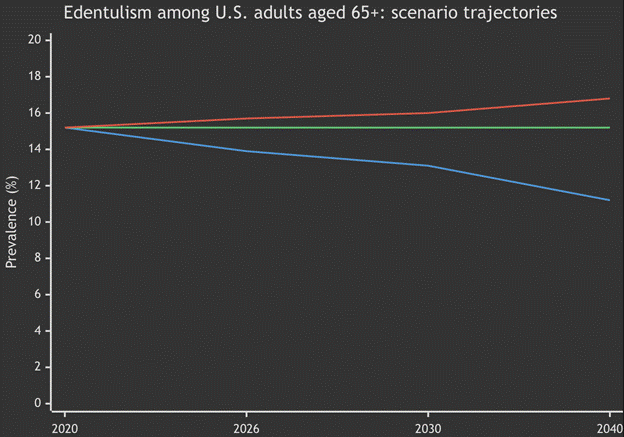
Lines represent, respectively, continued improvement, plateau and adverse-equity scenarios. Baseline data are from CDC/NHANES; later values are modelled assumptions.
Even the improvement scenario does not guarantee fewer affected people. By 2030, all surviving baby boomers will be older than 65 and approximately one in five U.S. residents will be of retirement age.
In New Hanover County, 19.43% were already 65 or older in 2023 and population growth of 16.3% is projected by 2030.
Thus, demand for periodontal maintenance, complex restorations, dentures, implant-supported treatment, domiciliary services and medically coordinated dental care is likely to grow.
For patients, these trends reinforce the importance of addressing oral health problems early and having a plan to restore function when teeth cannot be preserved.
At Otero Cosmetic & Implant Dentistry in Hampstead, NC, Dr. Misael Otero helps patients protect their remaining teeth and explore personalized restorative options when tooth loss has already occurred.
Implications, research gaps and key sources

National policy should treat tooth retention as part of chronic-disease management rather than an isolated dental endpoint.
Diabetes, COPD, kidney, cardiovascular, oncology and cognitive-care pathways should incorporate oral-health assessment, medication-related dry-mouth review, referral and closed-loop follow-up.
Routine Medicare dental exclusion remains a structural barrier precisely where edentulism risk is greatest; the limited coverage for dental services “inextricably linked” to transplant, cardiac-valve, dialysis and cancer care is useful but does not substitute for prevention.
For Hampstead and New Hanover County, the immediate research priority is a county surveillance system combining BRFSS/PLACES estimates with Medicaid claims, safety-net clinic records and a probability-sampled clinical examination of adults aged 45 or older.
Analyses should oversample non-Hispanic Black residents, low-income adults, people aged 75 or older and patients with COPD, diabetes or multimorbidity.
Outcomes include tooth extractions, functional dentition, untreated caries, periodontal status, prosthesis use, dry mouth, dental attendance and avoidable emergency-department use.
Principal evidence gaps are the absence of recent nationally representative tooth-loss incidence; limited linkage of medical, pharmacy and dental claims; under-representation of nursing-home residents; sparse autoimmune-specific estimates; inadequate separation of disease effects from treatment effects; and few quasi-experimental evaluations of Medicaid expansion or integrated medical–dental programmes.
Future longitudinal work should use marginal structural models or target-trial emulation to address time-varying confounding, competing mortality and bidirectionality.
Key sources comprise the CDC’s 2024 Oral Health Surveillance Report and detailed edentulism table; the original national multimorbidity analysis by Zhang and colleagues; the Health and Retirement Study analysis of edentulism and cognitive decline; the 2025 New Hanover Regional Medical Center Community Health Needs Assessment; New Hanover County’s Older Adult Dental Program documentation; and official NHANES, MEPS, CMS and North Carolina Medicaid materials.
References
Table 18. Percentage of adults aged 65 years or older who were edentulous | Oral Health | CDC
Frontiers | Multiple Chronic Diseases Associated With Tooth Loss Among the US Adult Population
National Health and Nutrition Examination Survey (NHANES) – Healthy People 2030 | odphp.health.gov
Medical Expenditure Panel Survey Topics
Medicare Dental Coverage | CMS
Edentulism Predicts Cognitive Decline in the US Health …
2024 Oral Health Surveillance Report: Selected Findings | Oral Health | CDC
Prevalence of Tooth Loss Among Older Adults
Oral Complications of Cancer Therapies – NCI