
If you’ve worn dentures for twenty years or more, you’ve probably had days when you wondered if implants were ever really an option for someone like you.
Maybe a dentist mentioned it once and you filed it away. Maybe you’ve watched your dentures grow looser each year and figured that ship had sailed.
Here’s what actually happens in practice: dental implants after years of wearing dentures can still be an option, even when long-term denture wear has changed your jawbone.
Your treatment plan may simply look different from someone who lost a tooth more recently. The bone you have left, the shape of your gums, and how your bite has shifted all help determine what comes next.
This matters because long-term denture wearers often get vague answers or blanket promises that don’t hold up once a scan is taken.
A clear, honest look at your mouth (not your birth certificate or how many years you’ve worn dentures) is what actually determines your options.
Key Takeaways
- Decades of denture wear can still lead to a successful switch to implants, though the plan usually involves extra steps like grafting or angled placement.
- A 3D scan and medical history review, not your age or years in dentures, are what determine your real options.
- Solutions range from traditional implants to All-on-4 or zygomatic implants, depending on how much bone you have left.
Can Implants Still Be an Option After Decades of Dentures?
Implants can still work for most long-term denture wearers, even after 20, 30, or more years of tooth loss. The bigger question isn’t whether you qualify based on how long you’ve worn dentures.
It’s what your specific mouth needs to support a stable, comfortable result.
Why Years of Denture Wear Do Not Automatically Rule Out Treatment
Wearing removable dentures for decades doesn’t disqualify you from implant dentistry. Bone changes with time, but modern techniques were built to work around exactly this kind of change.
Many patients who assume they’ve “waited too long” find out during a consultation that they have more options than they expected.
Why the Same Implant Plan Does Not Suit Every Denture Wearer
No two mouths that have worn dentures for years look alike. Someone who switched to dentures at 45 has different bone and gum conditions than someone who’s worn them since their 60s.
That’s why an implant dentist builds a plan around your scan and history, not a one-size-fits-all approach to tooth replacement.
What “Suitable” Means in Implant Dentistry
Being suitable for implants isn’t a single yes-or-no label. It’s a combination of factors: bone volume, gum health, healing capacity, and your overall health.
A consultation at a practice like Otero Cosmetic & Implant Dentistry looks at all of these together, rather than ruling someone out based on one factor alone.
Why Long-Term Denture Use Changes the Jaw
Long-term denture use changes the shape and density of your jawbone, which is why switching from dentures to dental implants after many years often needs a different approach.
The bone that once held your natural teeth starts to change the moment those teeth are gone, and it keeps changing the entire time you wear removable dentures.
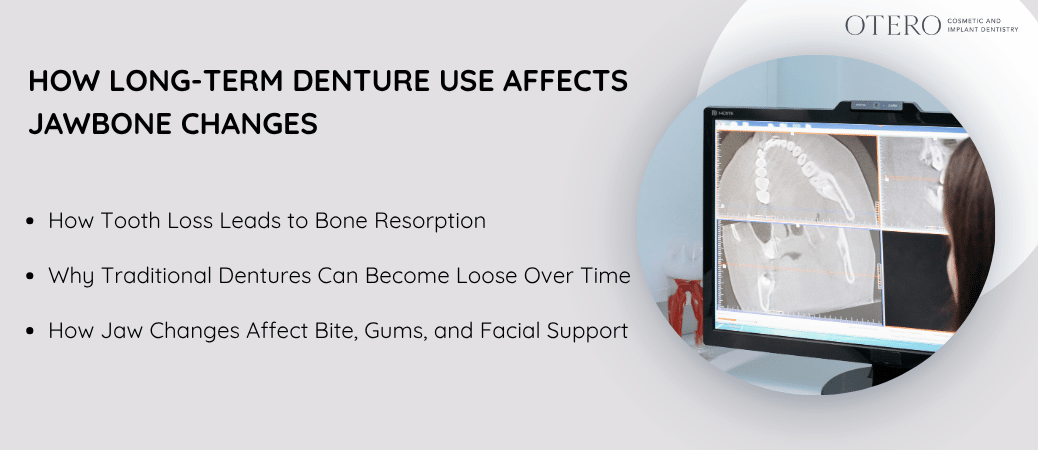
How Tooth Loss Leads to Bone Resorption
Your jawbone stays strong when teeth (and their roots) are in place, stimulating it every time you chew.
Once teeth are extracted, that stimulation stops, and the body begins to resorb, or break down, the bone that’s no longer being used.
This process, called bone resorption, is gradual but steady, and it’s the reason bone loss with dentures tends to show up more the longer someone goes without natural tooth roots or implants.
Why Traditional Dentures Can Become Loose Over Time
Traditional dentures rest on your gums and the ridge of bone underneath, so as that ridge shrinks, the fit changes too.
This is why dentures that felt secure years ago may now slip while eating or talking. Loose dentures often lead to more adjustments, more adhesive, and less confidence in social situations.
How Jaw Changes Affect Bite, Gums, and Facial Support
Bone loss changes more than fit. It can shift your bite, alter how your lips and cheeks are supported, and lead to sore gums from uneven pressure points.
Some long-term denture wearers also notice their face looks more sunken, since jawbone volume plays a big part in facial structure.
What Your Implant Assessment Must Show
A proper implant assessment needs to show your bone volume, your gum condition, and your overall health picture before anyone can recommend a treatment path.
Guesswork isn’t part of responsible implant dentistry, and skipping this step is how mismatched treatment plans happen.
How a 3D CBCT Scan Guides Implant Placement
A 3D CBCT scan (cone beam computed tomography) gives your dentist a detailed, three-dimensional view of your jawbone, including its height, width, and density in specific areas.
This image shows exactly where implant placement is possible without grafting and where it isn’t.
During a dental implant consultation at Otero Cosmetic & Implant Dentistry, this scan becomes the foundation for every recommendation that follows.
Why Medical History and Healing Risks Matter
Your medical history affects how your body heals around an implant, so it’s reviewed carefully before any plan is finalized.
Conditions like uncontrolled diabetes can slow healing and raise the risk of infection. Osteoporosis and certain osteoporosis medications, including bisphosphonates, can also affect bone healing and are factored into planning rather than treated as automatic disqualifiers.
How the Existing Denture Helps Plan the New Smile
Your current denture isn’t just something to replace. It’s a useful reference for your bite, tooth position, and facial support, giving your dentist real information about what has worked for your smile so far.
This helps guide decisions about the new restoration’s shape, length, and fit.
Which Implant Path May Fit Reduced Bone?
The right implant path depends on how much bone you have left and where it’s located, not on a single standard procedure.
Reduced bone volume doesn’t rule out fixed teeth. It simply changes which technique gets you there.
When Bone Grafting or a Sinus Lift Is Needed
Bone grafting adds material to rebuild areas where bone has thinned, giving future implants a stable base.
A sinus lift is a specific type of graft used in the upper jaw, where the maxillary sinus can sit close to the bone needed for implants.
Both approaches take healing time before implants can be placed, but they open the door to standard implant placement for many patients who wouldn’t otherwise qualify.
Learn more about how bone grafting works to prepare the jaw for implants.
How Angled Implants and All-on-4 Can Use Available Bone
Angled implants are placed at a tilt to reach denser, healthier bone that’s still available even after resorption has occurred.
All-on-4 uses this technique with four implants per arch to support a full set of implant-supported teeth, often without needing extensive grafting first.
This approach is compared in more detail in this guide to All-on-X versus traditional implants.
When Zygomatic Implants May Be Considered
Zygomatic implants are considered when the upper jaw has lost too much bone for even angled implants to work well.
These longer implants anchor into the cheekbone (the zygomatic bone) instead of the jaw itself, offering a fixed solution for cases of severe upper-jaw bone loss.
You can read more about how zygomatic implants compare to grafting in cases like this.
Choosing Between a Snap-In Denture and Fixed Full-Arch Teeth
Palateless snap dentures use implant support to provide greater stability while remaining removable for cleaning, while a fixed full-arch restoration stays secured to the implants.
The table below compares these two paths at a glance.
| Feature | Implant-Retained Overdenture | Fixed Full-Arch Restoration |
| Removable by patient | Yes | No |
| Number of implants (typical) | 2 to 4 | 4 to 6 |
| Bone requirement | Lower | Moderate to higher |
| Daily cleaning | Removed and cleaned separately | Cleaned in place, like natural teeth |
| Feel while eating | Some movement possible | Closer to natural bite |
From Scan to a Stable, Maintainable Smile
Getting from your first scan to a finished, stable smile takes several distinct stages, each with its own healing timeline.
Rushing any one of them raises the risk of problems later, which is why a realistic schedule matters more than a fast one.
What Happens During Implant Placement Surgery
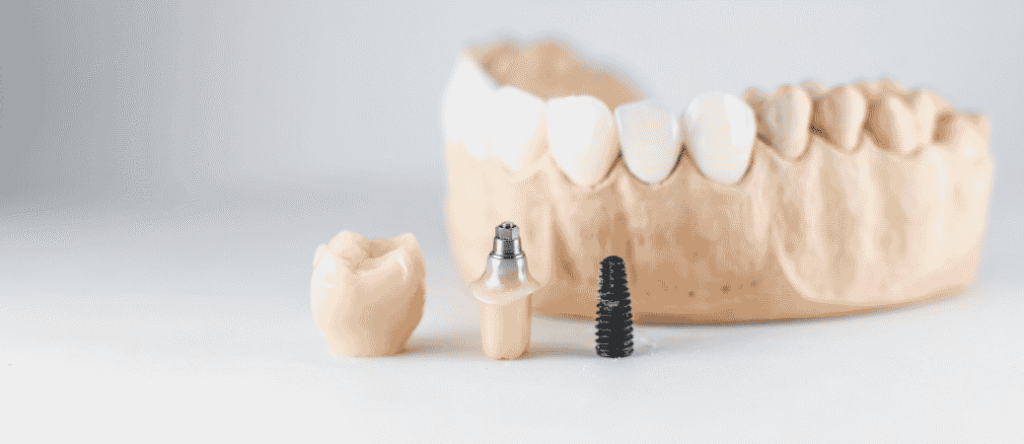
Implant placement surgery involves inserting small titanium posts, acting as artificial tooth roots, into the jawbone.
Depending on your treatment plan, this may happen alongside grafting or as a separate step once grafted bone has healed.
Most patients go home the same day with instructions for managing swelling and diet.
Why Temporary Teeth and Healing Cannot Be Rushed
Temporary teeth protect the surgical site while your bone and gums heal, and rushing past this stage can compromise the final result. Healing time varies by patient and treatment type, but skipping ahead before the bone is ready puts the whole restoration at risk.
Your care team at Otero Cosmetic & Implant Dentistry coordinates each stage so temporary teeth transition to your final restoration only when your mouth is truly ready.
How Osseointegration Supports the Final Restoration
Osseointegration is the process where bone grows around and fuses with the implant surface, creating a stable foundation.
This bonding process is what allows an implant restoration to function like a natural tooth root, supporting chewing forces without shifting.
It’s also part of why implants help with bone preservation, since the implant continues stimulating the bone the way a natural root once did.
How to Protect Implants for the Long Term
Protecting your implants means keeping up with daily oral hygiene and regular checkups to catch early signs of peri-implantitis, a gum infection that can affect the tissue around an implant.
Getting enough protein, calcium, and vitamin D supports healing and long-term bone health as well. With consistent care, implants are built to support a natural-looking smile for many years.
A Personal Plan Can Make the Switch Possible

Long-time denture wearers often carry a quiet assumption that they’ve missed their chance for implants, but that’s rarely how it works out.
Long-term denture use changes the starting point, not the destination.
Denture wearers who come in for an honest evaluation, rather than guessing at their own candidacy, usually leave with more clarity than they expected.
Dental implants after dentures aren’t about erasing the years you’ve spent on removable teeth.
hey’re about building a plan around where your mouth is right now, using the bone and gum tissue you actually have.
That’s a very different starting point than assuming the answer is no before anyone’s even looked.
Frequently Asked Questions
Can you get dental implants after wearing dentures for 20 years?
Yes, many patients who have worn dentures for 20 years or longer are still candidates for implants. The plan may include bone grafting or angled implant techniques depending on how much bone remains, but a clinical assessment is what determines your actual options.
What if I do not have enough jawbone for dental implants?
Reduced bone doesn’t automatically rule out implants, since options like bone grafting, sinus lifts, angled implants, and zygomatic implants were developed for exactly this situation.
Your scan will show which of these paths fits your jaw, and implant-supported dentures may also be an option if you prefer a removable solution.
Is there an age when dental implants are no longer appropriate?
There’s no specific age cutoff for dental implants. Candidacy depends more on your overall health, healing ability, and bone condition than the number of years you’ve lived or worn dentures.
Will I need to go without teeth during implant treatment?
Most patients wear temporary teeth throughout the healing process, so you won’t be without a functional smile.
Your dentist will fit these temporaries early in treatment and adjust them as your mouth changes during healing.
Are implant-supported dentures easier to care for than traditional dentures?
Implant-supported dentures tend to stay more secure day to day, which reduces the friction and adjustments common with traditional dentures.
Daily care still involves cleaning around the implants and the denture itself, along with good oral hygiene habits and regular checkups to catch any issues early.