
Research conclusion
Research on teeth whitening adverse effects shows an important limitation: no public U.S. data source can tell researchers exactly how often whitening causes harm across the American population.
Clinical studies provide a clearer picture of specific effects, with temporary tooth sensitivity and gum irritation among the most consistently reported concerns.
For patients considering treatment, professional teeth whitening provides a guided approach that can be planned around sensitivity, existing restorations, and individual cosmetic goals.
Under controlled conditions, temporary sensitivity is a common adverse effect of whitening, while the documented risk of lasting harm appears low in the available clinical evidence, while professionally placed veneers show high survival, with mechanical failure as the main problem.
The strongest whitening evidence comes from the American Dental Association (ADA), whose clinical guidance states that mild to moderate sensitivity can affect up to two-thirds of users early in bleaching and usually resolves by the fourth day after strip or tray treatment ends.
A 2025 updated meta-analysis in Operative Dentistry found no significant difference in sensitivity risk between at-home and in-office bleaching (relative risk 0.82; 95% CI 0.61–1.10), although sensitivity was less intense at home and the evidence was rated low quality.
For veneers, a 2021 systematic review in the Journal of Clinical Medicine pooled 6,500 porcelain laminate veneers, of which 433 failed, and estimated 10-year cumulative survival at 95.5%.
A 2023 meta-analysis in the Journal of Evidence-Based Dental Practice reported pooled survival of 88% for resin composite veneers over mean follow-up of 24 to 97 months.
For research purposes, the defensible conclusion is therefore:
Professionally supervised peroxide whitening reliably produces short-lived sensitivity and gum irritation, with serious harm documented mainly in case reports and high-concentration ingestions.
Ceramic veneers bonded to enamel by trained dentists are durable, while composite veneers fail more often.
Neither profile can be extrapolated to do-it-yourself, non-dentist or overseas treatment, where the evidence consists largely of surveys, warnings and anecdotes rather than measured rates.
What should count as “a complication”?
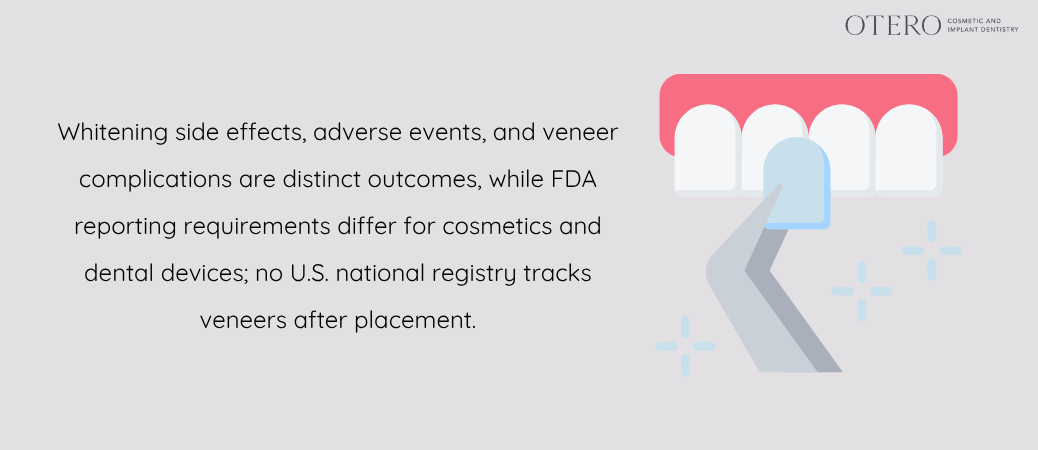
Vocabulary is a frequent source of error. A side effect is an expected, usually short-lived response, such as sensitivity during bleaching.
An adverse event, as defined for cosmetics under the Modernization of Cosmetics Regulation Act of 2022 (MoCRA), is any health-related event associated with a cosmetic that is adverse, and it does not require proof of causation.
A complication is a clinically meaningful unwanted outcome, such as a chipped veneer or pulpal inflammation.
Survival and success are trial endpoints defined differently across studies: in veneer research, survival usually means the restoration is still in the mouth, even if repaired, while success means it never needed intervention.
A veneer can therefore survive while having had a complication.
The two treatments also sit in different regulatory systems. In 2014, responding to an ADA citizen petition, the Food and Drug Administration (FDA) said most peroxide whiteners meet the definition of a cosmetic, with drug status judged case by case.
Cosmetic reports appear on FDA’s Adverse Event Monitoring System public dashboard, and since December 29, 2023, MoCRA has required companies to report serious adverse events within 15 business days.
Whitening lights and veneer ceramics are medical devices, so device problems go to FDA’s MAUDE database. No U.S. national registry follows veneers after placement.
| Data source | What it establishes | Can it be called a complication rate? |
| FDA cosmetic adverse event reports (most whiteners) | That someone reported a suspected adverse event | No — no denominator of users |
| FDA MAUDE (whitening lights, dental ceramics) | Device malfunctions and injuries, mainly reported by manufacturers | No — counts, not rates; under-reporting is well known |
| America’s Poison Centers (National Poison Data System) | Exposures and outcomes reported to poison centres | No — captures calls, not all users |
| Randomized trials and meta-analyses | Event risk under defined protocols | Yes, but only for the patients and protocols studied |
| Dental board complaints and malpractice claims | That a dispute or claim arose | No — reflects complaint behaviour, not clinical incidence |
| Professional surveys of dentists | That dentists have seen complications | No — measures clinician experience, not patient risk |
These sources should not be treated as interchangeable. A rising number of dashboard reports, for example, may reflect MoCRA’s new reporting mandate rather than more harm.
U.S. evidence from the past five years
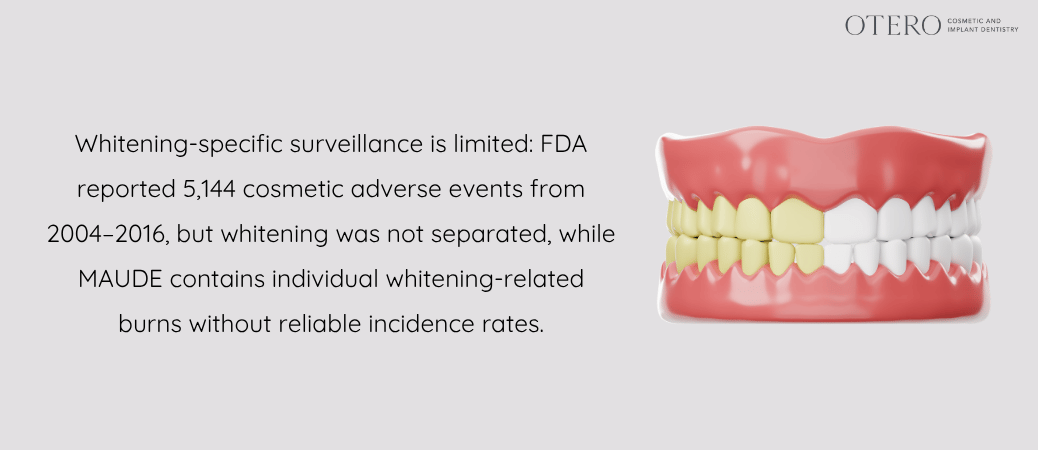
Federal surveillance yields few whitening-specific numbers.
A 2017 research letter in JAMA Internal Medicine found 5,144 cosmetic adverse events reported to FDA from 2004 to 2016, an average of about 396 a year, led by hair and skin products; oral care products were not reported separately.
No published count of whitening-specific reports was found for 2021–2026, so researchers would need to query the FDA dashboard directly and interpret results cautiously.
Device data are similarly thin. An older Journal of the American Dental Association analysis (2015) found 28,046 dental-device adverse event reports in MAUDE between 1996 and 2011, only 1.4% of all device reports.
Dental implants dominated, and veneers, ceramics and bleaching lights did not appear among the top 20 device types.
Individual MAUDE entries describe lip and gum burns linked to chairside whitening systems, which shows such events occur but says nothing about how often.
Poison centre data mark the rare serious end of the spectrum. A study in Annals of Emergency Medicine (2017) identified 294 symptomatic ingestions of peroxide above 10% concentration reported to U.S. poison centres over a decade, of which 13.9% involved embolic events and 6.8% ended in death or continued disability.
That study concerned industrial-strength peroxide, not whitening kits. An older Utah poison centre series found children accounted for 71% of hydrogen peroxide exposures, with more severe outcomes above 10% concentration.
It is reasonable to infer that the main risk to children lies in high-concentration gels sold outside normal retail channels, although no U.S. dataset isolates whitening products.
What the evidence says about whitening and veneer safety
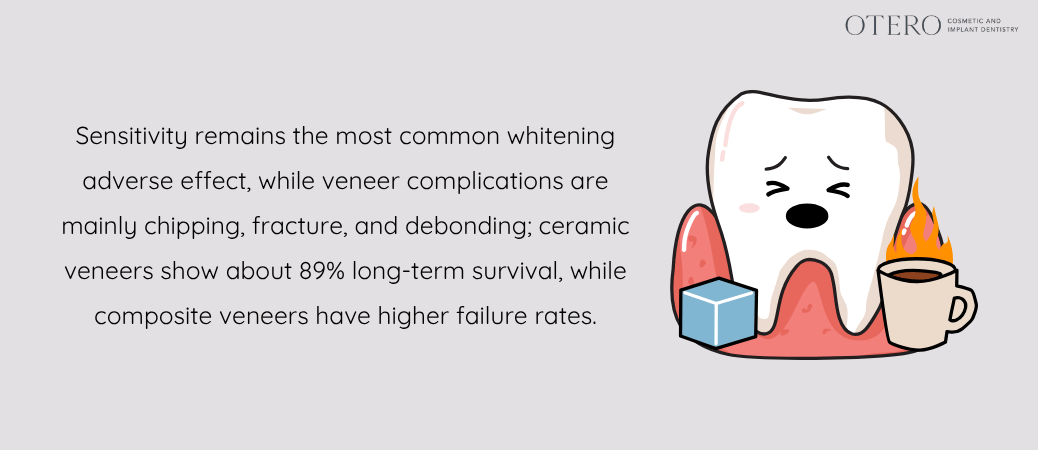
Sensitivity is the dominant adverse effect, and the evidence on what drives it has shifted.
A 2021 network meta-analysis in Operative Dentistry, covering 32 studies of eight light-activation systems, found no evidence that light activation affects the risk or intensity of sensitivity, contrary to an older 2012 meta-analysis that had reported higher odds with light.
A 2026 umbrella review concluded with moderate certainty that roughly 25–35% hydrogen peroxide whitens about as well as higher concentrations with less sensitivity.
Desensitizing agents reduced sensitivity after in-office whitening in a 2023 meta-analysis of blinded trials, although it appeared in a lower-profile journal.
The ADA also notes that whitening does not change the colour of existing restorations, which matters for patients who already have veneers or bonding.
When planning cosmetic treatments, a professional evaluation can help determine how whitening, existing restorations, and other cosmetic treatments can work together to create a more consistent result.
Peroxide-free products are often marketed on safety claims that outstrip the evidence.
Laboratory studies of phthalimidoperoxycaproic acid (PAP) report less enamel erosion than hydrogen peroxide, but the best-known study was produced by authors affiliated with a PAP manufacturer, a University of Mainz laboratory study found PAP gel toxic to human gum cells, and a 2025 laboratory study found no significant colour change with PAP and LED light.
No clinical trials establish PAP’s real-world adverse event profile. Do-it-yourself methods such as lemon juice, vinegar, abrasive pastes and charcoal are supported mainly by expert warnings and laboratory erosion data rather than population studies.
For comparison, European Union rules limit whiteners sold directly to consumers to 0.1% hydrogen peroxide, allow 0.1–6% only when a dentist provides or supervises the first use, and ban use under age 18.
The United States has no equivalent federal concentration cap, so U.S. consumers can buy a wider range of strengths.
Veneers. Pooled clinical data consistently identify fracture or chipping and debonding as the leading failures, followed by marginal discoloration, secondary decay and nerve problems.
A landmark 2016 meta-analysis by Morimoto and colleagues reported 89% survival at a median of 9 years, higher for glass-ceramic (94%) than feldspathic porcelain (87%).
A 2025 review in the Journal of Esthetic and Restorative Dentistry reported short-term survival of 97.8% for ceramic veneers, though with high variation between studies.
A 2024 meta-analysis in the Journal of Prosthetic Dentistry found veneers bonded to enamel outperformed those bonded to dentin or old composite; veneers on composite showed 94% survival but only 70% success.
Composite veneers carry higher risk. In the 2023 meta-analysis, direct composite veneers survived at 91% and indirect ones at 84%.
A 10-year practice-based study in Dental Materials (2022) found composite veneers had about four times the failure hazard of ceramic veneers.
These outcomes come from academic or experienced operators and cannot be extrapolated to average practice, let alone to unregulated settings.
For unregulated settings, the evidence changes type rather than simply worsening. In 2024 the ADA warned about so-called veneer technicians, citing risks of infection, nerve damage from improper filing and choking, and ADA News has flagged snap-on veneers that trap food against teeth.
On dental tourism, the best data are not from the United States: a 2022 British Dental Association survey found 95% of responding UK dentists had seen patients treated abroad and 86% of those had treated complications.
That survey measures what dentists have seen, not patient risk, and equivalent U.S. data were not found.
Wilmington, North Carolina: local signal
North Carolina holds an unusual place in this topic. In North Carolina State Board of Dental Examiners v. FTC (2015), the U.S. Supreme Court ruled 6–3 that the dentist-controlled board was not immune from federal antitrust law after it sent at least 47 cease-and-desist letters to non-dentist teeth whiteners without active state supervision.
The Court noted that the state’s Dental Practice Act did not say whether whitening is dentistry. The ruling concerned who may regulate competition, not whether non-dentist whitening is safe.
Researchers should check the current Dental Practice Act and board rules before stating who may lawfully whiten teeth in North Carolina today.
No public board dataset breaking down complaints or disciplinary actions by whitening or veneers was found.
Demographics suggest substantial demand. The U.S. Census Bureau estimates New Hanover County’s population at 245,959 in July 2025, up 9.0% since 2020, with median household income of $75,166.
However, demographic and market signals cannot establish how often whitening complications occur locally because no public dataset tracks the number of treatments performed alongside adverse outcomes.
These sources are local signals, not complication-rate data.
A city-level complication rate cannot be computed because no denominator exists: there is no public count of whitening sessions, kits sold, or veneers placed in Wilmington.
The absence of local reports about complications should not be treated as evidence that complications are absent.
Outlook beyond 2026 and research implications
The likely direction is more data rather than better data. MoCRA’s mandatory reporting and FDA’s public dashboard will increase whitening-related report counts, and pending manufacturing and safety-substantiation rules may improve product quality.
Because MoCRA’s definition of a serious event includes second- or third-degree burns and significant disfigurement, chemical burns from high-concentration gels should become more visible.
Reports will still lack denominators, however, and imported or black-market gels may never be reported.
Product trends are also moving faster than the clinical evidence.
Peroxide-free formulas, LED home kits, minimal-preparation veneers, computer-milled ceramics, social-media do-it-yourself trends and dental tourism are all growing, so any projection of falling complication rates from newer materials should be treated as speculative until long-term trials report.
For future research, the most useful U.S. study would use standardised definitions, separate survival from success, and report method-specific rates for in-office, dentist-dispensed, over-the-counter and unsupervised whitening.
It would follow veneers for at least 10 years, recording preparation type and whether bonding was to enamel or dentin.
The most practical vehicle is a practice-based research network such as the National Dental Practice-Based Research Network, which could capture real-world denominators across community practices and link them to FDA reports and to follow-up of patients treated abroad.
Overall assessment: adverse event and complication data support cautious confidence in professionally delivered whitening and enamel-bonded ceramic veneers.
Whitening’s common harm is temporary sensitivity, and veneers mostly fail mechanically rather than biologically.
These findings should not automatically be applied to unsupervised do-it-yourself whitening or treatment performed by non-dental providers, where standardized safety data are limited.
References
Modernization of Cosmetics Regulation Act of 2022 (MoCRA) | U.S. Food and Drug Administration
MAUDE Adverse Event Report: Chairside Whitening System | U.S. Food and Drug Administration
Whitening (Oral Health Topics) | American Dental Association
At-home vs In-office Bleaching: An Updated Systematic Review and Meta-analysis | Operative Dentistry
A Radical-Free Approach to Teeth Whitening | Dentistry Journal
Council Directive 2011/84/EU of 20 September 2011 | Official Journal of the European Union
Outcomes After High-Concentration Peroxide Ingestions | Annals of Emergency Medicine
Hydrogen Peroxide Exposure: 325 Exposures Reported to a Regional Poison Control Center | PubMed
Is Hydrogen Peroxide Safe? | Poison Control, National Capital Poison Center
10-Year Practice-Based Evaluation of Ceramic and Direct Composite Veneers | Dental Materials
Statement on Recent Reports of “Veneer Technicians” | American Dental Association
Latest TikTok Trend Could Harm Teeth: DIY Veneers | ADA News
Dental Tourism | British Dental Association
Contemporary Dental Tourism: A Review of Reporting in the UK News Media | British Dental Journal
In the Matter of North Carolina State Board of Dental Examiners | Federal Trade Commission
Review of North Carolina Board of Dental Examiners v. FTC | North Carolina General Assembly
QuickFacts: New Hanover County, North Carolina | U.S. Census Bureau
https://www.census.gov/quickfacts/fact/table/newhanovercountynorthcarolina/INC110222