
Getting new full or partial dentures is a big step, and you want them to fit well from the moment you first put them in. The way your dentures are made plays a huge role in how they feel on day one.
Digital dentures use computer technology and precise measurements, while traditional dentures rely on manual techniques that have been used for many years.
Digital dentures typically provide a more accurate fit on the first day because they are created using 3D scans and computer-guided milling, which reduces human error in the fabrication process.
This matters because a better initial fit means you spend less time going back for adjustments. You can get back to eating and speaking normally faster.
The difference between digital dentures vs conventional dentures affects more than just comfort.
The digital workflow reduces turnaround time and often requires fewer appointments compared to conventional denture-making.
Understanding how each type is made helps you know what to expect when you sit in the dentist’s chair for the first time with your new dentures.
Key Takeaways
- Digital dentures offer better precision and fit on day one due to computer-guided design and manufacturing
- The fabrication method affects how many appointments you need and how quickly you get your dentures
- Both digital and traditional dentures can provide good results, but digital options reduce adjustment time
Table of Content
- How Fabrication Methods Shape Day-One Fit
- Materials and Fabrication Technologies
- Precision, Customization, and Types of Dentures
- Patient Experiences and Clinical Workflow
- Future Trends in Denture Fabrication
- Frequently Asked Questions
How Fabrication Methods Shape Day-One Fit
The way your dentures are made directly affects how they feel in your mouth on the first day you wear them.
Digital dentures follow a streamlined path using computer technology, while traditional dentures rely on manual steps that take more time and visits to your dentist.
Digital Denture Workflow Explained
The digital denture workflow starts when your dentist uses an intraoral scanner to capture detailed images of your mouth.
This scanner creates a 3D model of your gums and jaw without the need for messy impression materials.
Your dentist also records your bite registration digitally during the same appointment. The digital files go straight to a lab where technicians design your dentures using computer software.
Once the design is complete, machines mill or 3D print your dentures from pre-made materials. This digital fabrication technique captures both internal and external surfaces needed for proper fit.
The entire process typically requires only two appointments. You can often receive your finished dentures within a few weeks of your first visit.
Traditional Denture Workflow Compared
Traditional dentures require your dentist to take physical impressions of your mouth using trays filled with putty-like material. You bite down on these materials, which harden to create molds of your gums.
Your dentist sends these impressions to a lab where technicians hand-pour plaster models. They then manually build up layers of wax and arrange individual teeth one by one.
The conventional methods of fabricating a denture require several manual steps and processes. Each step adds time and introduces chances for small errors.
You’ll need multiple appointments spread over several weeks or months. Most patients visit their dentist at least four to six times before receiving final dentures.
The Role of Impressions, Scanning, and Wax Try-In
Digital impressions eliminate the gagging and discomfort many people experience with traditional impression trays.
The scanner captures thousands of data points in minutes, creating highly accurate measurements of your mouth’s unique shape.
Traditional impressions can shift or distort slightly as they set and during transport to the lab. These small changes can affect how your dentures fit on day one.
The wax try-in appointment is a key difference between methods. With traditional dentures, you try on a wax version to check tooth position and bite before final processing.
Digital dentistry often skips this step, though some dentists still offer a try-in stage using printed models.
Key differences:
- Digital: Direct scan to computer design, minimal distortion
- Traditional: Physical molds that can warp, multiple material transfers
- Accuracy: Digital measurements capture more detail consistently
Why Fewer Appointments Make a Difference
The number of visits affects more than just your schedule. Each appointment in the traditional workflow involves human handling of materials, which can introduce small variations.
Digital removable dentures reduce chairside time and streamline the process.
Fewer appointments mean less time between your initial visit and receiving your dentures.
Your mouth changes slightly over time, so a shorter timeline helps ensure the measurements taken at your first appointment still match your gums when you get your dentures.
Digital workflows also let your dentist store your denture design digitally. If you lose or break your dentures later, the lab can quickly print a replacement without starting from scratch.
Materials and Fabrication Technologies
The materials used in digital and conventional dentures differ significantly in their composition and processing methods.
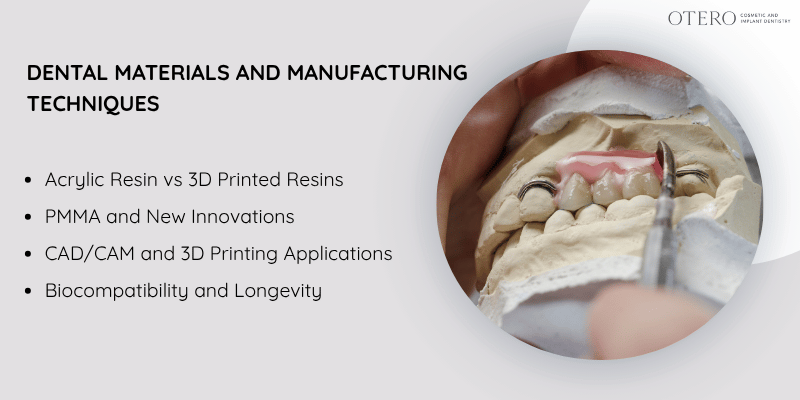
Digital denture fabrication relies on pre-polymerized resins processed through milling or 3D printing, while conventional methods use heat-cured acrylic resin that’s manually processed in a laboratory.
Acrylic Resin vs 3D Printed Resins
Traditional denture fabrication uses heat-cured acrylic resin that your dentist’s lab technician mixes, packs into molds, and processes under heat and pressure.
This material has been the standard for decades because it’s affordable and reliable.
3D printed dentures use photopolymer resins that cure layer by layer when exposed to light. These resins come pre-made from manufacturers, which means they have consistent quality every time.
You get dentures fabricated using digital design with materials that are already tested and standardized.
The main difference is control. Conventional acrylic resin can vary slightly based on how it’s mixed and processed. 3D printed resins eliminate this variation because they’re pre-formulated.
PMMA and New Innovations
PMMA (polymethyl methacrylate) forms the base of both conventional and digital denture materials. It’s a durable plastic that works well in your mouth.
Digital dental technology has introduced improved PMMA formulations designed specifically for milling or printing. These newer versions often have better strength and wear resistance than traditional acrylic.
Some manufacturers add nanoparticles or other reinforcements to make the material stronger.
Milled dentures use PMMA blocks that are already fully cured. This means less shrinkage compared to conventional processing. Your dentures maintain their shape better from fabrication to insertion.
CAD/CAM and 3D Printing Applications
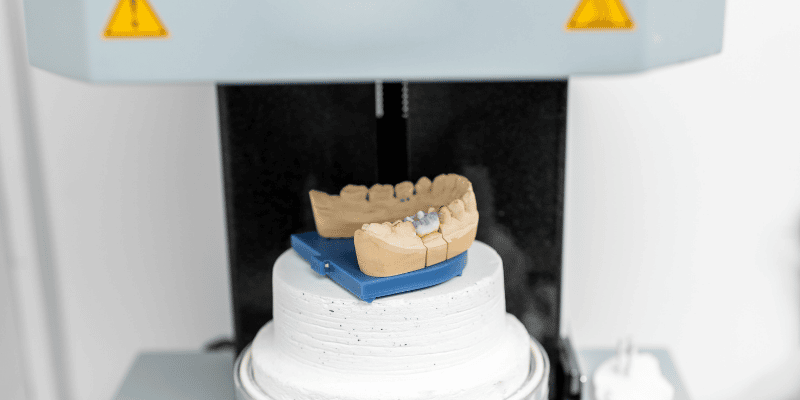
CAD/CAM technology allows your dentist to design your dentures on a computer and mill them from solid blocks of material.
The milling machine cuts away excess material to create your final denture base and teeth.
3D printing builds your dentures layer by layer. A light source cures liquid resin in precise patterns until your complete denture forms.
Digital dentures can be created through either milling or 3D printing, and both methods produce accurate results.
Both technologies use digital scans of your mouth instead of traditional impressions. This means your dentures are designed with exact measurements captured digitally.
Biocompatibility and Longevity
All denture materials must be safe for long-term use in your mouth. Both conventional and digital materials undergo rigorous testing to ensure they don’t cause allergic reactions or tissue irritation.
Pre-polymerized materials used in digital dentures often have fewer residual monomers than conventional acrylic. This can mean less potential for allergic reactions in some patients.
Longevity depends more on how you care for your dentures than the fabrication method. Both digital and conventional dentures can last many years with proper maintenance.
Digital materials may resist staining and wear slightly better due to their industrial curing process, but the difference isn’t dramatic.
Precision, Customization, and Types of Dentures
Both digital and conventional dentures come in complete and partial forms, but the fabrication method directly affects how accurately they fit your mouth from the first try.
The level of precision and customization available differs between traditional and modern approaches.
Complete Dentures Versus Partial Dentures
Complete dentures replace all of your teeth in the upper or lower jaw. They rest on your gums and create suction to stay in place.
You’ll need complete dentures if you’ve lost all your teeth or need all remaining teeth removed.
Partial dentures fill gaps when you still have some natural teeth left. They attach to your existing teeth using metal clasps or precision attachments.
Partials are removable dental prosthetics you can take out and clean yourself.
Both types can be made using conventional methods or through a digital denture workflow.
The fabrication process affects how well they fit on day one, regardless of whether you need complete or partial replacements.
Accuracy and Repeatability of Fit
Digital dentures use computer scans of your mouth to create a precise 3D model. This digital approach removes human error from multiple manual steps.
The computer-designed denture matches your mouth’s exact shape down to tiny details.
Conventional dentures rely on physical impressions made with trays and molding materials. Each step from impression to final denture involves handwork that can introduce small variations.
These variations may require adjustments after you receive your dentures.
Digital fabrication offers greater accuracy and a more predictable fit from the start. If you ever need a replacement, the digital file can recreate the exact same denture.
Conventional methods require starting the entire process over with new impressions.
Customization Options for Function and Aesthetics
You can customize both digital and conventional dentures for appearance and function. Tooth color, shape, and arrangement affect how natural your smile looks.
Gum color and texture also play a role in creating realistic dental prosthetics.
Digital systems offer precise control over these details through computer software. You can preview changes before manufacturing begins.
Adjustments to tooth position or bite alignment happen digitally rather than through physical alterations.
Conventional prosthodontics allows customization through skilled technician work. The lab technician manually sets each tooth and shapes the gum material.
This hands-on approach has worked well for decades but depends heavily on individual skill levels.
Looking for a better fitting denture solution? Contact our dental office to get expert advice.
Patient Experiences and Clinical Workflow
Digital dentures typically require fewer appointments than conventional methods, which changes how you’ll spend your time in the dental office.
The denture workflow also differs in how adjustments are handled and how your dental records are stored for future use.
Chair Time and Appointment Efficiency
Conventional dentures usually need four to five appointments over several weeks. You’ll visit for initial impressions, bite registration, try-in appointments, and final delivery.
Digital dentures can cut this down to two or three visits. The digital impressions process eliminates the need for traditional impression materials that some patients find uncomfortable.
Your dentist captures digital scans of your mouth instead of using trays filled with putty-like material.
Studies on digital versus conventional denture fabrication show that the streamlined denture workflow saves time at each appointment.
You spend less time in the dental chair because digital scans take only a few minutes. The try-in step might be skipped entirely with some digital systems, though this varies by provider and individual needs.
Adjustment and Remake Considerations
Both digital and conventional dentures may need adjustments after delivery. Your mouth needs time to adapt to new dentures, regardless of how they were made.
Research comparing milled and printed dentures suggests that milled digital dentures may perform better than printed versions.
However, your dentist may face a learning curve when first adopting digital technology.
If remakes are needed, digital dentures offer an advantage. Your dentist already has your digital records saved, so creating a replacement doesn’t require starting from scratch with new impressions.
Digital Record-Keeping for Future Needs
When you get digital dentures, your dental records exist as computer files rather than physical molds. These files stay accurate indefinitely and don’t degrade over time.
If you need repairs or replacements years later, your dentist can access the original digital design. This makes future denture fabrication faster and more predictable.
You won’t need to go through the full impression process again unless your mouth structure has changed significantly.
Physical molds from conventional dentures can crack, warp, or get lost. Digital files eliminate these storage concerns and make it easier if you move to a new dental provider who can access your records.
Future Trends in Denture Fabrication
New materials and scanning methods are making digital dentures faster and more accurate. Artificial intelligence is starting to help dentists design better-fitting dentures in less time.
Advancements in Digital Dentistry
Intraoral scanners are getting better at capturing the detailed shapes of your gums and mouth. These scanners can now record how your jaw moves and how your bite works together.
This means fewer appointments where you need to bite down on messy impression materials.
Artificial intelligence is starting to play a role in denture design. Computer programs can now suggest tooth positions based on your facial features and bite patterns.
This technology learns from thousands of previous cases to predict what will work best for your mouth.
Digital dentistry improvements are making it easier for dental labs to create dentures that fit well on the first try.
Software updates allow dentists to show you what your new dentures will look like before they’re made. You can request changes to the tooth color or shape during this digital preview phase.
3D Printing Innovations
New 3D printing materials are becoming stronger and more natural-looking. These materials can now match the properties of traditional denture materials while being printed in hours instead of days.
Multi-material printers can create dentures with different hardness levels in one print job. The pink gum part can be softer while the teeth are harder. This wasn’t possible with older printing methods.
Printing speed continues to improve each year. What once took 12 hours to print might now take only 4 hours. Faster printing means you could potentially get your dentures sooner.
What’s Next for Patient Care
Same-day dentures might become more common as technology gets faster. Some dental offices are already testing workflows where you could walk in without teeth and leave with a temporary set the same day.
Remote monitoring tools could let your dentist check how your dentures fit without you coming into the office. You might take photos or scans at home that get sent to your dental team for review.
Expert consensus on digital restoration suggests that more dental practices will adopt digital workflows in the coming years. This means you’ll have more options for where you can get digitally made dentures.
The cost of digital dental technology is also expected to decrease as more manufacturers enter the market.
Frequently Asked Questions
Digital dentures use computer technology to scan, design, and create dentures with fewer visits and more precision.
Most patients need about two appointments instead of five, though some adjustment is still normal.
What are digital dentures, and how are they made compared with traditional dentures?
Digital dentures are made using computer-aided design and computer-aided manufacturing technology instead of manual methods. Your dentist scans your mouth with a digital scanner to create a 3D model on a computer.
Software then designs the tooth arrangement with mathematical precision. The dentures are either milled from pre-made material or 3D printed layer by layer.
Traditional dentures require your dentist to take physical impressions with putty-like material. A lab technician pours these impressions in stone and manually arranges teeth in wax.
The dentures go through a heating and pressing process to set the final shape.
Each step in the conventional process can introduce small errors through shrinkage and manual handling. Digital workflows reduce these error sources while keeping a permanent digital record of your dentures.
How do 3D-printed dentures compare with regular dentures in terms of comfort and durability?
3D-printed dentures use special photopolymer resins that are approved by the FDA for use in your mouth. These materials have improved a lot since they first came out in 2015.
Digital dentures made with light-cured liquid resin are less likely to break than traditional ones. They need less maintenance over time.
Milled digital dentures use the same plastic material that dentists have used since 1937. The difference is that the material is pre-hardened in a factory under controlled conditions.
This eliminates the shrinkage that happens when traditional dentures are processed with heat and pressure.
Do digital dentures tend to fit better right away, or is adjustment still common?
Digital dentures offer greater consistency and accuracy through digital scanning and computer-based design. The pre-hardened materials used in milling eliminate shrinkage problems that affect conventional dentures.
You’ll likely need fewer adjustment appointments with digital dentures. However, some adjustment is still normal because your mouth needs time to adapt to any new denture.
The digital process gives your dentist a preview of how your dentures will look before they’re made. This helps catch issues early and reduces surprises on the day you receive them.
How does a digital impression for complete dentures work, and is it more comfortable than traditional impressions?
A digital impression uses a small handheld scanner that takes thousands of photos of your mouth. Your dentist moves the scanner around to capture all the surfaces needed for your dentures.
The scanner creates a 3D model on a computer screen in real time. You can see the model being built as your dentist scans.
Many patients find digital scanning more comfortable than traditional impressions. You don’t have to deal with trays filled with putty material that can trigger your gag reflex.
The scanner doesn’t require you to hold still with uncomfortable material in your mouth for several minutes.
How much do digital dentures typically cost, and what factors affect the price?
The cost of digital dentures varies based on your location, the dentist’s experience, and the materials used. Milled dentures and 3D-printed dentures may have different price points.
Your total cost depends on how many appointments you need and whether you require immediate dentures after tooth removal. Insurance coverage also affects what you’ll pay out of pocket.
Digital workflows typically reduce turnaround time compared to traditional methods. Fewer appointments can mean less time off work and lower overall costs even if the denture price itself is similar.
Can digital dentures be made as an immediate complete denture after extractions?
Yes, digital dentures can be made as immediate dentures that you wear right after your teeth are removed. Your dentist takes digital scans before your extractions to plan the denture design.
The digital workflow allows your dentist to predict how your gums will look after healing. This helps create dentures that fit better during the initial healing period.
You’ll still need follow-up appointments as your gums heal and change shape.
The advantage is that your dentist has your digital records saved and can make adjustments or create new dentures more easily when needed.