

Losing a tooth starts a chain reaction in your jaw: without the tooth root, bone begins to shrink, and the place where you once had strong support can weaken over months and years.
If you wait to get an implant, you risk losing bone volume that makes later implants harder and may require bone grafting.
Thus, delaying dental implants leads to bone loss. That loss can change how your face looks and raise the time, cost, and complexity of care.
You have options even after bone loss, and many modern techniques can rebuild bone and place implants successfully.
This article shows how delay affects bone, what to expect if you’ve waited, and which treatments can restore your jaw so implants work well.
Key Takeaways
- Early implant placement helps preserve jawbone and simplify treatment.
- Waiting often leads to bone loss that may need grafting before implants.
- Modern grafting and implant methods can restore bone and support implants.
Why Immediate Dental Implants Matter After Tooth Loss
Immediate implants help keep your jaw strong, keep your face looking fuller, and improve the chance that the implant will join well with your bone. Acting quickly can reduce the need for extra surgeries and shorten the overall treatment time.
Bone Resorption Begins Quickly
When you lose a tooth, the jawbone no longer receives the chewing forces that keep it healthy. Without that stimulus, the bone starts to shrink, often within days. Studies and clinical reports show noticeable bone loss in the first few months and up to a large percentage in the first year if nothing replaces the tooth root.
Placing an implant right after extraction restores that mechanical load. The implant’s titanium post transmits chewing forces into the jaw, which slows or prevents bone resorption. This reduces how much ridge augmentation or bone grafting you might need later.
If you wait years, the bone can thin in both height and width. That loss can make implant placement harder, increase surgical steps, and raise costs. Acting early preserves more of your natural bone and simplifies treatment.
Jawbone Density and Implant Success
Jawbone density strongly affects implant success because the implant must fuse tightly to bone, a process called osseointegration. Higher bone density gives more contact area for the titanium post, which boosts initial stability and long-term support.
Immediate implant placement often uses the existing socket to position the post where the root was. This maintains bone volume around the implant and supports faster osseointegration. If bone is already lost, dentists commonly need grafts that add months to healing before you can place the implant.
Your medical history matters too. Conditions like osteoporosis or long-term smoking reduce bone quality and can lower implant success rates. Getting an implant sooner lets you use your existing bone before those factors cause more damage.
Preserving Facial Structure
The jawbone supports your lips and cheeks. Losing bone after a tooth extraction can slowly change how your lower face looks. Over time, lost height and width in the jaw can cause a sunken look around the mouth and reduce chewing efficiency.
An immediate implant restores the root function that preserves bone volume, helping maintain your natural facial contours. This matters not only for appearance but also for how your teeth come together when you bite and chew.
When implants keep bone levels stable, you avoid many complex cosmetic or reconstructive procedures later. That saves time, reduces surgery, and keeps your smile and facial shape looking closer to how they were before tooth loss.
Discover your options for dental implants in Wilmington, NC. Contact our team today to learn how implants can restore your smile and confidence.
Consequences of Delaying Dental Implant Placement
Delaying implant placement can change the shape and strength of the jaw, affect nearby teeth, and alter how you chew and speak. These changes often require extra treatments later, like bone grafts or orthodontics.
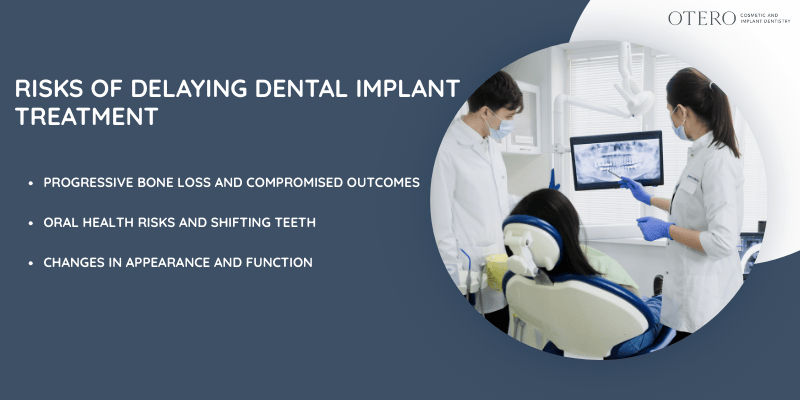
Progressive Bone Loss and Compromised Outcomes
When a tooth is lost, the jawbone no longer gets the pressure it needs to stay strong. Within months the bone where the tooth sat begins to shrink. Over years, this can mean not enough bone to anchor a standard implant.
Less bone may force your dentist to add procedures such as bone grafting or use special implants. Those steps add cost, extend treatment time, and can reduce predictability of success. Bone loss around dental implants also becomes a risk if implants are placed into weakened or thin bone. You can protect your options by replacing teeth sooner, which helps keep bone height and density.
Oral Health Risks and Shifting Teeth
A gap allows nearby teeth to tilt or drift toward the empty space. That shifting changes your bite and can create hard-to-clean gaps.
Poor alignment raises the chance of food traps and plaque buildup. That leads to gum inflammation and receding gums, which further weaken bone support.
You may then need orthodontic work, periodontal treatment, or extractions before any implant placement. Acting early reduces the cascade of problems that begin with tooth movement and end with more complex oral health care.
Changes in Appearance and Function
Missing teeth and jawbone loss change how your face looks and how well you chew. Bone loss can make cheeks sink and lips lose support, subtly changing your profile over time.
Functionally, you may start avoiding certain foods because chewing becomes harder. Speech can also alter if front teeth are missing.
Restoring a tooth sooner helps preserve facial contours and keeps chewing and speaking normal. If you delay, you might need more complex prosthetics to rebuild both bone and soft tissue before an implant will work.
Restoring Bone for Delayed Dental Implants
If you wait to replace a missing tooth, you may need extra steps to rebuild the jaw so an implant fits and stays stable. These steps focus on adding bone where it shrank, protecting grafts while they heal, and choosing the right materials for long-term support.
A study shows that when there is not enough bone in the upper jaw after tooth loss, dental implants can become more difficult to place safely and successfully.
The research explains that bone loss in the back of the upper jaw often requires procedures like sinus lift surgery to rebuild bone height, highlighting how reduced bone density directly impacts implant planning, stability, and long-term success.
Bone Grafting Techniques and Materials
When your jaw loses height or width, a bone graft adds volume so an implant can anchor properly. Your dentist may use an autogenous bone graft taken from your chin or hip. Autografts fuse well and speed up bone regeneration because the tissue is your own.
If you prefer not to have a second surgery site, an allograft (donor bone) or synthetic graft can work. These materials act as a scaffold while your body grows new bone into the area. Clinicians often mix graft types to balance healing speed and structural support.
Expect local anesthesia and a short recovery. Your clinician will stitch the site and may give antibiotics. Follow instructions: avoid smoking, keep the area clean, and wait the recommended healing time before implant placement.
Sinus Lift and Ridge Augmentation
If the upper back jaw lost bone height, a sinus lift raises the sinus floor and places graft material beneath it. This gives you 4–10 mm or more of new bone where implants would otherwise be too short. The procedure can use autograft, allograft, or synthetic bone depending on your needs.
For a narrow or sunken ridge, ridge augmentation rebuilds width and shape along the crest of the jaw. Surgeons place graft material and often a membrane to hold it in place while bone grows. Ridge work restores the gum contour and prevents implant threads from showing.
Both procedures need healing time, often 4–9 month, before standard implants are placed. In severe upper jaw loss, your team might discuss alternatives like zygomatic implants that anchor in the cheekbone to skip grafting.
Guided Bone Regeneration
Guided bone regeneration (GBR) uses a barrier membrane to protect graft material and steer bone growth into the right spot. The membrane keeps fast-growing gum tissue out, so slower-growing bone can fill the defect.
Membranes come as resorbable (dissolve on their own) or non-resorbable (may need removal). Your clinician will choose based on graft size and location. GBR often pairs with particulate grafts or block grafts for larger defects.
Post-op care matters: avoid pressure on the site, follow oral hygiene rules, and attend follow-up visits. Good care raises the chance that regenerated bone will integrate with your future implant and support it for the long term.
Dental Implant Options for Challenging Bone Conditions
You can still get fixed teeth even when your jaw bone is thin or heavily resorbed. Several implant approaches give you strong support, avoid long grafting in some cases, and restore chewing and speech.
All-on-4 and All-on-X Dental Implants
All-on-4 places four implants to support a full-arch bridge; All-on-X uses more implants when bone allows. These systems use angled posterior implants to gain more contact with available bone and reduce the need for bone grafting. You get a fixed prosthesis attached soon after surgery in many practices, so you leave with working teeth the same day.
Key benefits:
- Higher implant stability from angled placement.
- Shorter treatment time vs. staged grafts.
- Predictable loads across the arch, which lowers risk of single-implant failure.
Expect a careful assessment with 3D imaging, and plan for regular check-ups. If you have severe maxillary bone loss, your dentist may still recommend different techniques or grafting before final prosthesis placement.
Mini and Zygomatic Implants
Mini implants are narrow-diameter fixtures used when bone width is limited. They work best for stabilizing dentures or for small single-tooth sites but may not suit heavy chewing forces long-term. Minis can be a less invasive, lower-cost option when you need quicker healing.
Zygomatic implants anchor into the cheekbone (zygoma) for patients with extreme upper jaw atrophy. They bypass the maxillary bone entirely, giving high primary stability without grafts.
Zygomatic placement requires experienced surgeons and CBCT planning because of nearby sinus and nerve anatomy. Recovery can be longer, but zygomatic implants offer a durable full-arch anchor when standard implants won’t work.
Full-Arch Restoration Solutions
Full-arch restoration combines implant type and prosthetic design to replace all teeth on an arch. Options include implant-supported fixed bridges, hybrid prostheses, and removable overdentures.
You and your clinician will weigh implant number, prosthesis material (acrylic vs. zirconia), and occlusion to protect implant stability over time.
Important planning steps:
- 3D scan to map bone volume and vital anatomy.
- Choose implant positions for even force distribution.
- Decide immediate vs. delayed loading based on bone quality.
A well-planned full-arch restoration gives you stable chewing, improved speech, and easier oral hygiene compared with removable dentures. Consider maintenance needs and annual exams to keep implants healthy.
Ready to move forward with dental implants in Wilmington, NC? Schedule your appointment today and take the first step toward a healthier smile.
Factors Influencing Implant Success and Healing
You need to know the main things that affect how well an implant heals and stays stable. Bone quality, gum health, daily habits, and your medical conditions shape the risk of implant failure and the speed of implant integration.
Healing Time and Osseointegration
Osseointegration is the direct bond between bone and implant. It usually takes weeks to months. Denser jaw bone (especially in the lower jaw) gives faster primary stability. Softer bone in the upper jaw needs more time and careful loading to avoid failure.
Your surgeon may wait 3–4 months before placing a final crown in delayed protocols. Immediate placement can save time but raises risk of early loss if the implant lacks firm stability.
Factors that slow bone healing include poor bone volume, infection, and some medications like long-term steroids. Your surgeon may use bone grafts or select specific implant surfaces to improve integration.
Gum Disease and Peri-Implantitis
Active periodontal disease increases the chance your implant will fail. Bacteria from untreated gum disease can spread to the implant and cause peri-implantitis, which leads to bone loss around the implant.
Signs to watch for are red or swollen gums, bleeding on probing, pus, and increasing pocket depth. Early peri-implant mucositis affects the soft tissue and can be reversed with cleaning.
Once bone loss begins, treatment is more complex and success rates drop. Treat periodontal disease before implant placement and get regular checks to catch inflammation early.
Oral Hygiene and Lifestyle Habits
Good home care lowers the chance of implant complications. Brush twice daily, use interdental brushes or floss around implant crowns, and consider an antiseptic rinse if your dentist recommends it.

Smoking reduces blood flow and delays healing, doubling or tripling implant failure risk in some studies. Heavy alcohol use and illicit drug use also harm healing. Your dentist may ask you to quit smoking before surgery and during the first months of healing. Routine professional cleanings every 3–6 months help prevent peri-implantitis and protect long-term success rates.
Patient Health Considerations
Chronic conditions affect bone healing and implant survival. Poorly controlled diabetes raises infection risk and slows osseointegration. Osteoporosis can reduce bone density and increase failure risk, especially if you take bisphosphonates.
Medications matter: bisphosphonates and some immune-suppressing drugs can raise complication risk. Age alone is less important than the overall health and bone quality. Tell your dentist about all medicines and medical history so they can plan timing, choose grafting if needed, or delay treatment until conditions improve.
Comparing Dental Implants to Other Tooth Replacement Options
You need to know how each option affects jaw bone and long-term function. The next parts compare how dentures, implant-supported dentures, and timing of implant placement change bone loss, comfort, and maintenance.
Traditional Dentures and Bone Loss
Traditional dentures sit on your gums and replace only the visible part of teeth. They do not replace roots, so the jawbone under the denture loses stimulation and slowly resorbs. Over months to years this can change your face shape and make dentures fit worse.
You may need new dentures often because the bone shrinks. Denture wear can also rub gums and cause sore spots. If you plan to replace missing teeth with dentures, expect regular relines and more frequent visits to keep fit and comfort.
If you already have significant bone loss, traditional dentures may be the most affordable option. But they do not stop bone loss, so consider other choices if preserving bone and chewing efficiency matter to you.
Implant-Supported Dentures
Implant-supported dentures anchor to dental implants that act like tooth roots. That root replacement gives jawbone stimulation and slows or stops bone loss near the implants. You get better chewing strength and a more stable fit than with traditional dentures.
There are two common styles: removable overdentures that clip onto implants, and fixed hybrid dentures screwed to an implant bar. Removable versions are easier to clean. Fixed versions feel more like permanent teeth and need more implants and higher cost.
For many patients, implant-supported dentures strike a balance: improved bone preservation and function compared with traditional dentures, while still replacing multiple teeth at once.
Immediate and Early Implant Placement
Immediate implant placement means putting an implant into the socket right after extraction. Early placement occurs a few weeks to a few months later, once initial healing begins. Both aim to reduce the time your jaw goes without a root.
Immediate placement can preserve bone height and reduce treatment time, but it needs good bone and low infection risk. Early placement allows some soft-tissue healing and can be safer if infection or bone defects exist.
Your dentist will assess bone volume, infection, and overall health to choose timing. When feasible, immediate or early implants give better chances to maintain bone compared with waiting many months or years before replacing missing teeth.
Take control of your oral health with dental implants in Wilmington, NC. Schedule a consultation today and get a personalized treatment plan designed for you.
Frequently Asked Questions
This section answers common, specific concerns about bone loss after tooth loss, what affects implant options, and practical steps you can take to improve your chances for a stable implant. Read each short Q&A to learn how timing, bone health, and treatments affect your implant plan.
How does the loss of a tooth impact bone density over time?
When you lose a tooth, the jawbone stops getting bite forces at that spot. Without stimulation, the bone begins to shrink; most loss happens in the first few years.
Bone loss reduces height and width of the ridge. That change can make later implant placement harder or need extra grafting.
Can you still get a dental implant if bone density is low?
Yes, you can often get an implant when bone density is low, but you may need extra procedures first. Your dentist may recommend a bone graft, ridge augmentation, or a sinus lift to build enough bone.
A CT scan or X-ray will show how much bone you have. Your surgeon will pick the right graft material and timing for your case.
What is the ideal timeline for receiving a dental implant after losing a tooth?
Many clinicians prefer placing an implant within weeks to a few months after extraction to limit bone loss. If a bone graft is placed, waiting 3–6 months for healing before implant placement is common.
Delaying beyond 6–12 months can increase the chance you’ll need more bone work first. Talk to your oral surgeon about the best schedule for your mouth.
Are there ways to improve bone density before getting a dental implant?
Yes. Your dentist can place a bone graft to restore lost volume. Using autograft, donor bone, or synthetic materials helps the jaw rebuild.
You should also control gum disease, quit smoking, and keep good nutrition. These steps improve healing and graft success.
Why is it important to not delay a dental implant procedure?
Not placing an implant lets the jaw atrophy where the tooth was. That shrinkage can change your bite, alter facial support, and make restorations more complex.
Acting within months lowers the chance of needing extensive bone surgery later. It also keeps more straightforward implant options available.
What are the risks of postponing a dental implant?
Postponing raises the risk of bone resorption and loss of ridge width. You may face added procedures like repeat grafting, sinus lifts, or use of shorter or angled implants.
Other risks include shifting adjacent teeth, gum recession, and more complex surgery with longer recovery.