
Core findings
Recent evidence shows that dental implants in the United States are a high-survival treatment, but the headline number depends on what is being measured.
In a large U.S. multi-university dataset drawn from 10 dental schools, 50,333 implants placed between 2011 and 2022 had an implant-level failure rate of 1.4% and a patient-level failure rate of 2.7%.
In a related 2025 analysis of the same U.S. data source, overall implant survival was 98.6% over a mean follow-up of about 84 months.
As a longer-horizon benchmark, a systematic review estimated 10-year implant-level survival at 96.4%.
The most important point behind dental implant success statistics is that survival is not the same as success.
An implant may “survive” simply by remaining in the mouth, even if it has bone loss, soft-tissue inflammation, or prosthetic maintenance problems.
A recent systematic review of implant success criteria found that stricter “success” definitions usually require the absence of pain, mobility, infection, progressive radiographic bone loss, and unresolved prosthetic problems. This is why survival rates typically look better than full success rates.
How success should be defined in a research guide
For research purposes, the cleanest framework is to separate four outcomes: implant survival; implant success; biological complications; and replacement or reimplantation after failure.
The literature review on implant success criteria notes that pain, mobility, peri-implant infection, and bone loss after initial remodelling are central to defining true success, whereas “failure” is usually easier to define because it often results in removal or required removal.
In other words, a guide that reports only survival risks, overstating how uncomplicated implant therapy really is.
That distinction matters because complication burdens are not trivial. In a 2025 AO/AAP systematic review and meta-analysis, patient-level prevalence for peri-implant mucositis was 46% and for peri-implantitis was 21%.
The same review estimated weighted mean incidence within 20 years of function at 53% for mucositis and 22% for peri-implantitis. So even when implant loss is uncommon, inflammatory disease around implants is common enough that long-term maintenance has to be part of any realistic definition of success.
Longevity over five, ten, and twenty years
For the last five years of evidence, the strongest U.S.-relevant survival data come from large electronic-record cohorts and recent retrospective analyses.
The 2023 BigMouth study showed low implant-level failure across more than 50,000 implants, and the 2025 follow-on analysis found no meaningful survival disadvantage for immediate versus delayed placement, with both strategies yielding about 98.5% to 98.6% survival in this large retrospective population.
These are strong mid-term results, but they should not be confused with lifetime performance.
At ten years, the most cited systematic review still places implant-level survival at 96.4%, with a prediction interval of 91.5% to 99.4%. At twenty years, the evidence becomes thinner and more heterogeneous.
The 2024 meta-analysis of 20-year studies found prospective-study survival at 92% before imputation and 78% after imputation, while retrospective studies pooled at 88%; the authors summarised the practical message as roughly “4 out of 5 implants survive after 20 years.”
That is still a strong long-term result, but much less reassuring than 5- or 10-year figures, and it shows why very long-term maintenance cannot be treated as optional.
A second point about longevity is that the pool of people likely to seek implants is growing. In NHANES-based U.S. data, implant prevalence among adults aged 50 years and older increased from 1.3% in 1999–2004 to 8.4% in 2015–2020, and adults aged 65–74 reached 12.42% in 2015–2020.
At the same time, the CDC’s 2024 oral-health surveillance report found that adults aged 65 years or older had an average of 6.4 missing teeth due to disease, with edentulism affecting 11.4% of those aged 65–74 and 19.7% of those aged 75 or older.
The practical implication is that implant longevity matters more now because the treated population is larger and older.
What is known about replacement after failure
There is no single authoritative U.S. national replacement-rate statistic for failed implants in the sources reviewed.
The main reason is data architecture rather than biology: U.S. literature has historically been fragmented across academic centres and specialty settings, and a national community-practice registry has only recently been built.
A 2026 protocol paper for the National Dental Practice-Based Research Network explains that prior evidence on biological and prosthetic complications has been limited, often retrospective, and not representative of routine U.S. community practice; its new registry was designed precisely to quantify implant failures and complications more systematically over three years.
What can be measured now is the survival of implants placed after a prior implant has failed. In the 2024 U.S. BigMouth reimplantation study, 370 implants in 284 patients were replacements at previously failed sites.
Cumulative survival was 98.6% for first-time implants, 96.1% for first replacements, and 91.7% for second replacements.
First reimplants and second reimplants both had significantly higher failure risk than initial placements. That is one of the most useful U.S. findings for your topic, because it quantifies the way outcomes step down with each additional attempt.
The broader international evidence points in the same direction. A 2025 systematic review and meta-analysis found a 1-year survival rate of 96.7% after replacement at previously failed sites, with lower survival for second replacements than first replacements.
An earlier systematic review from 2020 reported a weighted mean retreatment survival of 86.3%, with reported follow-up ranging from less than 1 year to more than 5 years. Taken together, the literature supports a careful formulation: replacement is usually feasible, but it is less predictable than the first implant and should not be presented as a neutral reset.
Why implants fail over time
The literature continues to separate failure into an early phase and a later phase.
A recent review of removal and reimplantation strategies summarised early failures as being linked to factors such as smoking, diabetes, radiotherapy, bone quality, and periodontitis of remaining teeth, while later failures are commonly tied to peri-implant disease and progressive structural or occlusal problems.
The 2020 retreatment review reached a similar conclusion, arguing that many initial failures likely reflect modifiable factors such as implant architecture, anatomical site, infection, and occlusal overload.
For disease-related risk, the most stable finding in recent reviews is the importance of maintenance and plaque control.
A 2025 review noted robust evidence that people with a history of severe periodontitis, poor plaque control, and no regular maintenance care are at higher risk of peri-implantitis.
Smoking is also repeatedly associated with worse outcomes: a 2024 review found a significant correlation between smoking and increased implant failure in 25 of 33 studies reviewed.
These findings matter for a research guide because they explain why “how long do implants last?” has no single answer independent of follow-up care and patient risk profile.
Recent U.S. database studies also suggest that risk profiles are multifactorial rather than simple. In the 2023 U.S. multi-university analysis, race and ethnicity were associated with implant loss, while examined systemic conditions were not.
In the 2025 analysis of immediate versus delayed placement, age, ethnicity, race, gender, and asthma were significant in multivariable modelling.
These are observational findings, not causal proof, but they reinforce the point that failure risk is shaped by a layered mix of biology, behaviour, treatment design, and social context.
Outlook beyond 2026
The best-supported forecast beyond 2026 is not a precise failure percentage but a direction of travel: demand will probably continue to rise, and U.S. outcome measurement will probably improve.
On the demand side, the NHANES trend line is already steep, and the 2018 U.S. projection study estimated that implant prevalence among adults with missing teeth could reach 5.7% in a conservative scenario and 23% in a high-adoption scenario by 2026.
On the demographic side, the U.S. Census Bureau projects that by 2030, all baby boomers will be 65 or older, and by 2034, older adults will outnumber children for the first time in U.S. history.
That is a strong reason to expect continuing pressure for tooth replacement options, including implants, after 2026.
On the evidence side, the new U.S. implant registry is already substantial.
The 2026 protocol reported that 1,453 patients and 2,087 implant restorations had been registered between August 2022 and October 2024, with baseline data collected across a geographically diverse network of community practices and annual follow-up planned for three years.
That means post-2026 U.S. research should become much better at estimating complication incidence, not just crude survival.
For your topic, that is important because the next wave of data is likely to sharpen estimates of replacement need, prosthetic problems, and peri-implant disease in everyday practice rather than only in specialist centres.
Wilmington and the North Carolina Context
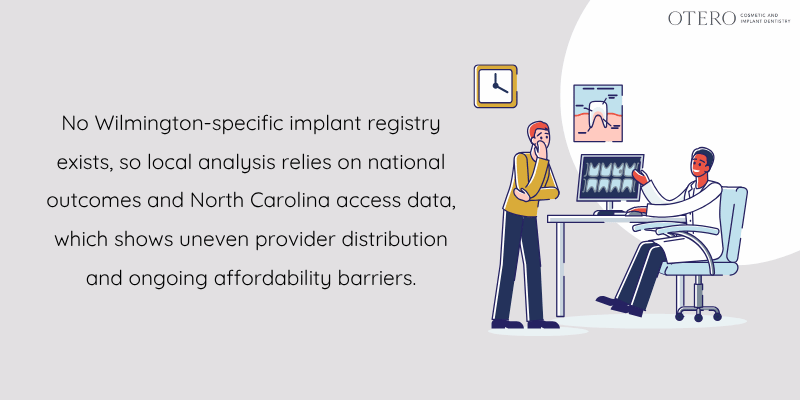
In the sources reviewed, I did not identify a public, Wilmington-specific implant survival registry.
For a research guide, the most defensible local approach is therefore to use national implant outcome data and then add state and county access context.
In New Hanover County, the county community health assessment identified access to care as one of the top three health priorities.
The county’s Older Adult Dental Program, launched in July 2022, provides comprehensive dental care for low-income adults aged 55 and older and lists exams, X-rays, cleanings, fillings, extractions, select root canals, dentures, and partials among its services.
That local service profile suggests that unmet need in the Wilmington area is strongly tied to access and affordability, not simply to a lack of implant awareness.
At the state level, recent sources are explicit that oral-health data remain incomplete.
A 2024 North Carolina Medical Journal commentary reported that adult and senior oral-health data in the state are sparse and that 97 of 100 counties are wholly or partly designated dental health professional shortage areas.
The 2024 North Carolina Institute of Medicine oral-health report likewise stressed workforce maldistribution and said dentists are highly concentrated in 9 of the state’s 100 counties.
At the same time, a 2024 UNC workforce analysis found that New Hanover County was one of the counties receiving a disproportionate share of new dentists between 2017 and 2021.
For Wilmington, that means local provider growth may be better than in many other parts of the state, but the broader North Carolina picture still argues for describing implant access as uneven and data on local outcomes as limited.
Research implications
A rigorous research guide on this topic should therefore state the findings in four separate layers. First, initial implant survival in recent U.S. cohorts is high, roughly 98% to 99% over mid-term follow-up and about 96% at ten years.
Second, true success is narrower than survival because it excludes pain, mobility, infection, and pathologic bone loss.
Third, replacement implants generally perform worse than first implants, with U.S. evidence showing survival dropping from 98.6% for first-time implants to 96.1% for first replacements and 91.7% for second replacements.
Fourth, local Wilmington/North Carolina interpretation should focus on access, workforce, and data gaps, because public local outcome surveillance is limited.
That framework will keep the guide accurate, methodologically clean, and aligned with the strongest sources now available.
References
Journal of the American Dental Association Study on Implant Survival
BigMouth Multi University Dental Implant Analysis
Review of Dental Implant Success Criteria
Systematic Review on Peri Implant Disease and Implant Success
Long Term 10 Year Dental Implant Survival Systematic Review
PubMed Study on Dental Implant Outcomes
National Dental Practice Based Research Network Implant Registry Protocol
Reimplantation Survival Study After Implant Failure
Meta Analysis on Replacement Implant Survival
Review of Implant Failure and Reimplantation Strategies
NHANES Dental Implant Prevalence Study
New Hanover County Oral Health Assessment