
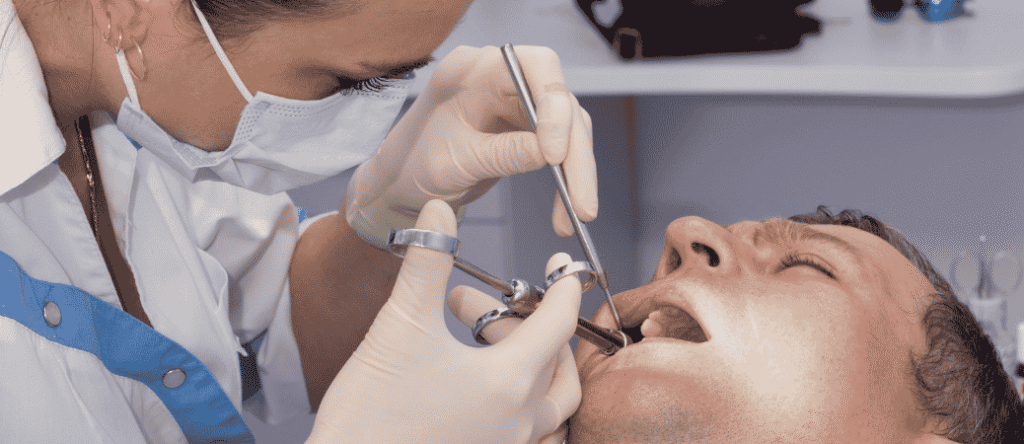
Full-arch treatment may combine several procedures in one coordinated plan.
When damaged or failing teeth cannot be preserved, tooth extractions can prepare the mouth for the next stage of implant treatment.
Two options come up most often for these cases: IV sedation and general anesthesia.
Understanding IV sedation vs general anesthesia for dental surgery can help you see why the right choice depends on the complexity and length of your procedure, your health history, your anxiety level, and the type of airway management you may need.
The choice between IV sedation vs. general anesthesia for full-arch surgery comes down to how long and complex your case is, your health history, how much awareness you can tolerate, and who is available to manage your airway while the surgeon works.
If you feel nervous reading this, that reaction is common.
Dental fear is one of the most frequent reasons people delay treatment for years, and a good anesthesia plan exists partly to solve that problem.
At Otero Cosmetic & Implant Dentistry, that conversation happens before anyone talks about surgery dates.
Key Takeaways
- IV sedation keeps you breathing on your own and lightly responsive, while general anesthesia makes you fully asleep with breathing support.
- Case length, health conditions like sleep apnea or lung disease, and anxiety level all shape which plan fits you.
- Numbing medicine is still used in both plans, because sedation controls awareness and comfort while local anesthetic controls surgical pain.
Table of Content
- What Separates IV Sedation From General Anesthesia?
- Which Factors Determine the Right Anesthesia Plan?
- Who Keeps You Safe During Surgery?
- What to Expect Before, During, and After Full-Arch Surgery
- Matching the Anesthesia Plan to Your Full-Arch Needs
- Frequently Asked Questions
What Separates IV Sedation From General Anesthesia?
The core difference is consciousness and breathing: with IV sedation you breathe on your own and can respond to voice or touch, and under general anesthesia you are fully asleep with an anesthesia provider supporting your airway.
Everything else, including recovery time and cost, follows from that one distinction.
Here is how the common choices line up for a full-arch case.
| Oral sedative + numbing | IV (moderate) sedation | General anesthesia | |
| Awareness | Awake, responsive | Drowsy, responds to voice | Fully asleep |
| Breathing | On your own | On your own | Supported by provider |
| Airway protected | No | No | Yes |
| Memory of surgery | Most of it | Little to none | None |
| Typical fit for full-arch | Rarely | Shorter or simpler cases | Long, complex cases |
| Relative cost | Lowest | Middle | Highest |
Many surgeons favor general anesthesia with a dedicated anesthesiologist for all-on-X cases, so the surgeon can concentrate fully on the procedure.
Nitrous oxide and oral sedatives sit at the lighter end of sedation options. They take the edge off short appointments and rarely carry a multi-hour full-arch surgery on their own.
What Does IV Sedation Feel Like During Full-Arch Treatment?
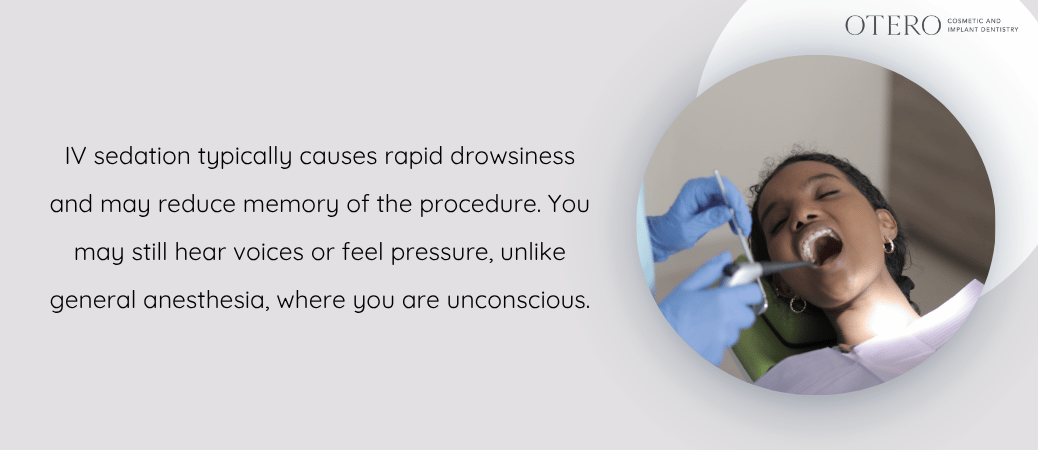
Most patients describe IV sedation as a warm, heavy drowsiness that arrives within a minute or two of the medication entering the IV line.
Midazolam and fentanyl are the two drugs used most often, and midazolam produces amnesia, so the hours you spend in surgery usually feel like a few minutes.
You may hear voices, feel pressure, or shift slightly when asked. You will not be paralyzed or unaware of your surroundings the way you would be under general anesthesia. Some people remember the IV going in and nothing after.
The term “twilight sedation” is marketing language for this same moderate to deep range. Conscious sedation is the older clinical term.
What Happens Under General Anesthesia?
Under general anesthesia, you lose consciousness completely and an anesthesia provider takes over your breathing, using a breathing tube or another airway device. You have no awareness of the surgery and no memory of it.
For full-arch work this brings practical advantages. The team gets absolute stillness, controlled fluids, and a protected airway during heavy irrigation, which helps when the surgeon is placing four to six implants and reshaping bone.
Deep sedation sits between the two. You are asleep but not intubated, and your breathing may need help.
Why Local Anesthetic Is Still Needed for Both Options
Numbing medicine goes into the surgical site whether you choose IV sedation or general anesthesia. Sedation controls awareness, anxiety, and memory.
Local anesthetic blocks the pain signals coming from the jawbone and gum tissue.
This matters for your expectations under IV sedation. You may still notice pressure, vibration, or the sensation of the injection itself, because pressure travels through nerves that numbing medicine does not fully silence.
Local anesthetic also keeps you comfortable in the first hours after you wake up, before oral pain medication takes hold.
Which Factors Determine the Right Anesthesia Plan?
Your anesthesia plan is built from three inputs: how long and involved the surgery will be, how much anxiety or gag reflex you bring to the chair, and what your medical history says about your ability to tolerate deeper sedation safely.
A proper medical evaluation happens before you are booked, not on surgery day.
How Procedure Length and Surgical Complexity Affect the Choice
Longer, more involved cases push the plan toward general anesthesia. A single-arch dental implant case with healthy bone and no extractions can often be handled comfortably with IV sedation.
Add several extractions, bone grafting, or both arches in one visit, and the clock stretches past three or four hours. That length changes things.
Staying still gets harder, sedation depth drifts more, and the surgeon benefits from a patient who cannot move at all.
All-on-4 and similar full-mouth implant cases involving bone grafting sit at the complex end of this range. So do cases needing zygomatic implants, where the anchorage reaches into the cheekbone.
When Anxiety, Dental Phobia, or a Strong Gag Reflex Matter
Severe dental phobia and a strong gag reflex are legitimate clinical reasons to choose deeper anesthesia, not personality quirks to apologize for.
A gag reflex that triggers during impressions will trigger during surgery, and it interrupts the work.
Past dental trauma shows up the same way. If a bad extraction years ago still makes your chest tighten in the waiting room, tell the team.
Many people with dental anxiety in adults do far better knowing they will be fully asleep than trying to white-knuckle a light plan.
Patients who say “I want to be completely out” are given real weight in that conversation.
How Medical History Changes Sedation Candidacy
Some conditions make deeper sedation riskier without airway control, and others make it safer to have an anesthesiologist present. Sleep apnea is the big one, because a partly obstructed airway under sedation can drop your oxygen quickly.
Poorly controlled diabetes, lung disease, reflux, heart conditions, high BMI, and certain medications all factor in.
Your anesthesia team assigns an ASA fitness score during the evaluation, and healthy patients rated ASA I or II are the most straightforward candidates for moderate IV sedation.
Bring your full medication list, including supplements and anything for weight loss, to that appointment.
Who Keeps You Safe During Surgery?
Safety during full-arch surgery rests on who is watching your breathing and how well the room is equipped to respond if something changes.
Under general anesthesia, that responsibility belongs to a dedicated anesthesiologist whose only job is you.

Why Airway Management Is a Central Difference
Under IV sedation your airway is unprotected, meaning nothing physically holds it open or blocks stomach contents.
You are breathing for yourself, which works well until sedation drifts deeper than intended.
That drift is the reason offices offering moderate sedation must be trained and equipped to rescue a patient who slips into deep sedation.
General anesthesia removes the guesswork by securing the airway from the start with a breathing tube or comparable device.
Fasting rules exist for the same reason. Most adults stop solids six or more hours before and can have clear liquids up to two hours before, though your team gives you exact times.
What Continuous Monitoring and Emergency Readiness Should Include
Continuous monitoring means someone is watching your numbers the entire time, not checking in between steps.
For moderate sedation, that includes pulse oximetry for oxygen saturation, blood pressure, and capnography to track exhaled carbon dioxide, which catches breathing problems before oxygen levels fall.
ECG gets added when your history calls for it, and deeper levels require full monitoring under ADA and ASA standards.
Ask what emergency equipment is in the room. A well-prepared office has oxygen, suction, an AED, reversal medications for the sedation drugs used, and a plan for allergic reactions.
What Credentials Should an Anesthesia Provider Have?
Ask directly who is administering your anesthesia and what permit they hold.
The qualifications required to administer sedation or general anesthesia depend on the provider’s training, credentials, and applicable state requirements.
Ask who will administer your anesthesia, what level of sedation they are qualified to provide, and who will monitor you throughout the procedure.
A separate anesthesiologist brings a different advantage. When one person runs anesthesia and another operates, neither is splitting attention.
Reasonable questions to ask at your consultation:
- Who administers and monitors my anesthesia, and is that their only role during surgery?
- What sedation permit or certification do they hold?
- What monitoring equipment stays connected the whole time?
- What happens if my sedation goes deeper than planned?
What to Expect Before, During, and After Full-Arch Surgery
Plan for a full day off, a responsible adult to drive you and stay with you, and roughly 24 hours before you feel like yourself again.
The logistics are simple once you know them, but they are not optional.
How to Prepare for a Sedation Appointment
Your office will give you exact fasting times. Follow them precisely, since aspiration risk is the reason they exist.
Practical prep that makes the day easier:
- Arrange a responsible adult to drive you home and stay several hours afterward
- Wear short sleeves and flat shoes, skip contact lenses and jewelry
- Take your regular morning medications only if your team clears them with a sip of water
- Fill pain and antibiotic prescriptions the day before
- Set up soft foods, ice packs, and pillows at home in advance
Rideshare does not count as an escort. Offices will reschedule you over this.
What Happens in Recovery and When You Can Resume Activities
You wake in a recovery area and stay until you meet discharge criteria, which usually takes 30 to 60 minutes after IV sedation and somewhat longer after general anesthesia.
Grogginess, mild nausea, and a dry mouth are common in that first stretch.
Do not drive, sign documents, cook, or care for children alone for 24 hours.
Most people return to desk work in two to three days, though surgical healing continues well past that; aftercare for all-on-X implants covers the weeks that follow.
How Sedation Costs, Dental Insurance, HSA, and FSA May Apply
Anesthesia is billed separately from the surgery, and general anesthesia costs more than IV sedation because of the facility requirements and the second provider.
Ask for the anesthesia fee in writing before you schedule.
Dental insurance coverage for sedation varies widely, and some plans cover it only when medical necessity is documented.
Medical insurance sometimes picks up general anesthesia when a documented condition requires it.
Matching the Anesthesia Plan to Your Full-Arch Needs

The right anesthesia plan for your full-arch case comes out of a conversation, not a default policy. IV sedation fits healthy patients with moderate anxiety and shorter surgical time.
General anesthesia fits longer cases, severe phobia, strong gag reflex, and health histories that call for airway control from the start.
Bring your medication list and your honest anxiety level to the consultation. Ask who manages your airway, what monitoring stays connected, and what the anesthesia fee is separate from the surgery.
Frequently Asked Questions
Is IV sedation less risky than general anesthesia for full-arch implants?
Neither option is universally safer, and both carry low risk when the provider is trained for that level and the office monitors you continuously.
IV sedation leaves your airway unprotected, which becomes a concern during long cases or if sedation drifts deeper than planned.
General anesthesia secures the airway but requires a fully equipped setting and a dedicated anesthesia provider.
Who is not a good candidate for IV sedation?
Patients with untreated sleep apnea, significant lung or heart disease, high BMI, severe reflux, or certain medication profiles often need general anesthesia with airway control instead.
People with severe dental phobia or a strong gag reflex are also poor fits, since moderate sedation may not keep them still through a multi-hour surgery.
Your anesthesia evaluation and ASA rating determine this.
How painful is IV sedation for dental implant surgery?
The IV placement itself feels like a brief pinch, and the surgery is kept comfortable by numbing medicine given after you are sedated.
Under IV sedation you may notice pressure and vibration during implant placement, though most patients remember little to none of it thanks to the amnesia effect of midazolam.
What is the safest sedation for full-arch dental work?
The safest plan is the one matched to your health history and your case length, delivered by a provider credentialed for that sedation level.
For long all-on-4 and full-arch cases, many surgeons prefer general anesthesia with a dedicated anesthesiologist so airway management and surgery are handled by separate people.
Will I need a breathing tube for general anesthesia during All-on-4 surgery?
Yes, general anesthesia includes airway support, typically a breathing tube placed after you are asleep, though some cases use an alternative airway device.
You will not feel it going in or coming out, and mild throat soreness for a day afterward is the usual aftereffect.
How long does it take to recover from IV sedation or general anesthesia?
Immediate recovery in the office runs about 30 to 60 minutes for IV sedation and somewhat longer for general anesthesia. Both require a responsible adult to drive you home and no driving, alcohol, or important decisions for 24 hours.
Most people feel mentally clear the next morning, while surgical healing continues for several weeks.